My Daughter Came Home From Cheer Practice and Wouldn’t Speak—The Next Morning, Her School Opened Her Locker
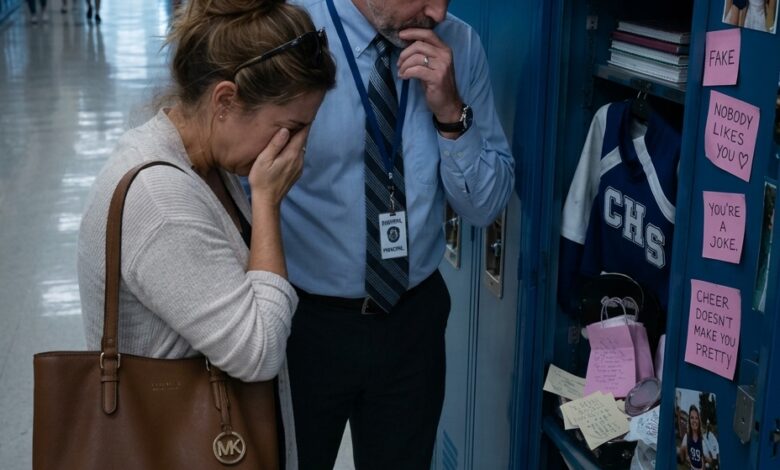
Riverside High treated the matter as a formal student-safety and disciplinary issue rather than dismissing it as ordinary teenage conflict. Mr. Hale and Coach Davis documented the physical notes and digital communications, investigated the students involved and put measures in place for Maya’s return; specific disciplinary outcomes remained private, as they appropriately should. Hannah’s family eventually sent a written acknowledgment through an attorney, a carefully filtered document Maya immediately recognized as something short of a genuine apology. She decided to write Hannah herself—not to threaten her or demand friendship, but to describe exactly what those six weeks had felt like. Hannah answered two days later in her own words, and Maya kept that response private, telling me only that it felt “more real” than the formal letter and that perhaps, someday, they could be okay without ever becoming friends again. Three days after I first saw the locker, Maya returned to school wearing her team hoodie deliberately: the building was still hers, the squad was still hers, and she had earned her position long before anyone tried to make her feel unwelcome in it. The following week she returned to practice. Some teammates were warm, others uncomfortable, and one apologized in a way Maya believed was sincere. When Coach Davis told her the team needed her to be exactly who she was, Maya came home exhausted but steadier. “It was weird,” she admitted, dropping her bag in our hallway. Then she said the sentence I had been waiting to hear: “But it’s still mine.”
Later that evening, Maya asked me about something I had briefly mentioned during those difficult days—a painful experience from my own adolescence when I had also done what I believed was right, suffered for it and kept the consequences from my mother until everything was over. When I finished, Maya looked at me and almost smiled. “So it’s hereditary,” she said. “We’re breaking the cycle.” We made an agreement that hard things no longer had to reach the equivalent of a locker full of threats before either of us spoke about them; she could still solve her own problems, but I wanted to know what was happening while it was happening, not receive the polished version after she had survived it alone. Then, with the astonishing ordinary resilience of a sixteen-year-old, she opened the refrigerator, announced that she wanted lemon pasta for dinner and poured herself cereal while she waited. Our dog Chester rested his head on her knee, and Maya scratched behind his ears as the evening light came through the kitchen window. “I’m going to be okay,” she said. This time her voice sounded different from the night she had locked her bedroom door. “I mean really okay. Not just saying it.” I told her I knew—I could finally hear the difference.