My Daughter Came Home From Cheer Practice and Wouldn’t Speak—The Next Morning, Her School Opened Her Locker
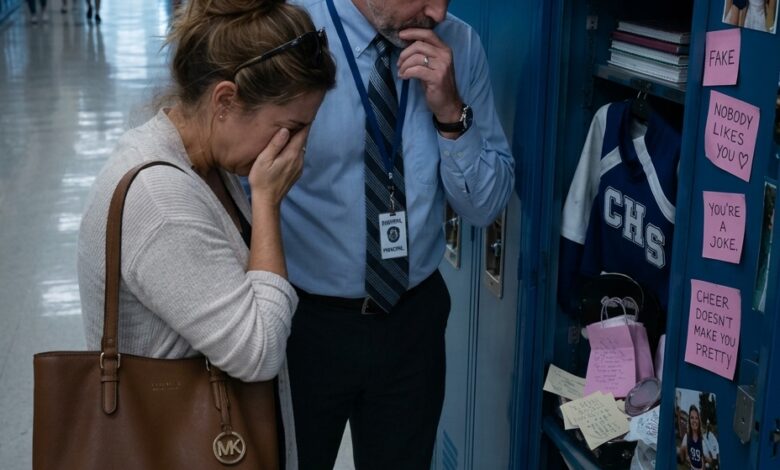
The principal opened my sixteen-year-old daughter’s locker, and for several seconds I could not understand what I was seeing. Handwritten scraps of paper covered the metal door and walls, wedged between Maya’s team photograph, mirror and the stickers she had collected since freshman year. Then I read the first note, followed by another, and the hallway seemed to narrow around me. They were not teenage jokes or careless insults—they were targeted threats using Maya’s name, details about her cheerleading team and private information that could only have come from people who knew her well. Mr. Hale stood beside me and quietly explained that the school had also uncovered weeks of messages across several online platforms. The night before, Maya had come home from practice with swollen red eyes, walked straight past me and locked her bedroom door, insisting she was simply tired. Looking at that locker, I finally understood that my daughter had not been tired at all—she had been carrying something alone for six weeks and had finally reached the point where she could no longer pretend it was manageable.
Maya had never been a child who demanded attention. She was observant, funny and unusually considerate, the kind of person who remembered something you mentioned weeks earlier and asked about it because she genuinely cared about the answer. Cheerleading was different: there she allowed herself to be ambitious. After failing her first tryout in eighth grade, she spent a year taking Tuesday-night tumbling lessons and strengthening herself for the demanding stunting work required by Riverside High’s competitive squad. She made varsity as a freshman and became a primary base and co-captain by sophomore year. Normally she returned from practice talking so quickly I could barely follow the stories, which was why the change that October should have frightened me sooner. She began answering questions with a few words, staring at messages before turning her phone facedown and leaving dinner early. When I asked whether something was wrong, she told me she was tired, and because I believed I knew when my daughter needed privacy, I gave it to her. What I did not know was that in September Maya had reported a teammate named Hannah to Coach Davis for violating team conduct rules. The report was accurate and the coach addressed it, but Hannah apparently interpreted accountability as betrayal—and what began as resentment soon became an organized campaign against the girl who had spoken up.
The school’s investigation showed how far that campaign had spread. What began in group chats and anonymous online messages had eventually moved into Maya’s physical space, culminating in the notes placed inside her locker. Several teammates appeared to know what was happening; some were suspected of participating, while others had simply watched and remained silent. When I returned home and told Maya I had seen everything, she finally unlocked her bedroom door. “I didn’t want you to know,” she admitted. “I thought I should be able to handle it.” Then she showed me the messages on her phone, and they were even more disturbing than the papers because they contained details proving that people within her daily circle had been watching, discussing and cataloging her life while continuing to smile at her during practice. Maya said the silence of teammates who knew was almost worse than Hannah’s cruelty. She also worried that reporting what happened would get Hannah removed from the team and insisted she had never wanted to “destroy” anyone; she had only wanted the harassment to stop. I reminded her that accountability was not something she was inflicting on Hannah—the disciplinary consequences belonged to the people who had made the choices that created them. Then Maya told me why she had stayed silent: “I thought if I said it out loud, it would become more real.” That was when I understood that the most dangerous part of those six weeks was not only what other teenagers had done to my daughter, but what Maya’s own competence had convinced her she was supposed to survive by herself.