My Neighbor Booted My Car Because She Hated Seeing It—She Wasn’t Prepared for What I Did Next
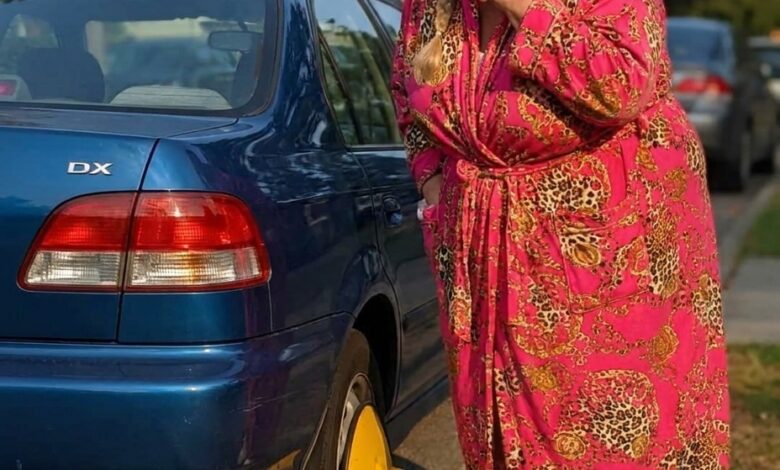
The yellow wheel clamp was impossible to miss against the faded gold of my twenty-year-old Honda, and for several seconds I simply stood on the cold February sidewalk staring at it. My car had been legally parked in front of my neighbor Linda’s house overnight, exactly where I had left it after coming home from work. There were no parking restrictions, no unpaid tickets that I knew of, and certainly no reason for the city to immobilize it. Then Linda appeared across the street in a cream-colored robe, coffee in hand, and began laughing. “I warned you,” she said, reminding me that only the day before she had threatened to make me “regret” parking where she could see my rusty old Civic from her window. I felt my anger rise, but instead of arguing, I took out my phone and photographed the clamp, my car, the curb, the absence of parking signs—and Linda standing nearby looking remarkably pleased with herself. Then I smiled, wished her good morning, borrowed my daughter’s car and drove to work with an idea beginning to form.
My name is Margaret, I am sixty-three, and I have lived on Chestnut Street for thirty-one years. The house where I raised my daughter Carrie is modest, the driveway was designed in 1952 and barely accommodates modern cars, and my 2004 Honda Civic—with 187,000 miles, rust around the wheel wells and a windshield crack I have postponed repairing—is unlikely to appear in anyone’s automotive calendar. But it runs, it is paid for, and it has carried me through seven years of widowhood, thousands of trips to the accounting firm where I work as a senior bookkeeper, and countless airport runs when Carrie comes home from Seattle. When Carrie and her husband temporarily moved in during a renovation, I gave them the driveway and began parking on the public street. Unfortunately, the nearest open space was often in front of Linda’s house. Linda had lived in the neighborhood for nine years and had gradually appointed herself its unofficial aesthetic authority. She had moved another family’s flowerpots because they looked “cluttered,” thrown my nine-year-old granddaughter’s bicycle into a recycling bin because it spoiled the appearance of my lawn, and complained about everything from hedges to holiday lights. I had tolerated it because neighbors have to continue living beside one another. But putting a wheel clamp on my legally parked car was different. During lunch that day, I checked the applicable local rules and confirmed what common sense had already suggested: a private resident generally cannot simply immobilize another person’s vehicle on a public street because she dislikes looking at it.
I could have reported Linda immediately, and I seriously considered it. I had photographs, a witness in Carrie and Linda’s own words connecting her to the clamp. Depending on local law, unauthorized interference with another person’s vehicle could potentially expose someone to civil liability or other legal consequences, and I intended to preserve my documentation in case the behavior continued. But sitting at my desk that afternoon, I realized I wanted something more useful than another neighborhood war. Linda’s real problem was not my Honda; it was her conviction that the view from her window somehow gave her authority over everything within it. So I ordered two enormous faux-terracotta garden planters, nearly three feet across, filled them with vigorous trailing plants, and arranged same-day delivery directly to Linda’s house. The card read: For Linda, with my warmest regards. I wanted to contribute something beautiful to your view. Your neighbor, Margaret. When I returned home, Linda was waiting beside the planters, furious. “What are these monstrosities doing in front of my house?” she demanded. “You said my car ruined your view,” I replied. “I thought I’d give you something nicer to look at.” Then I mentioned, as calmly as I could, that I had documented the wheel clamp and researched my legal options. For the first time in nine years, Linda stopped talking.