My Son Mocked Our Waiter With Down Syndrome—Then I Told Him About the Friend I Betrayed 20 Years Ago
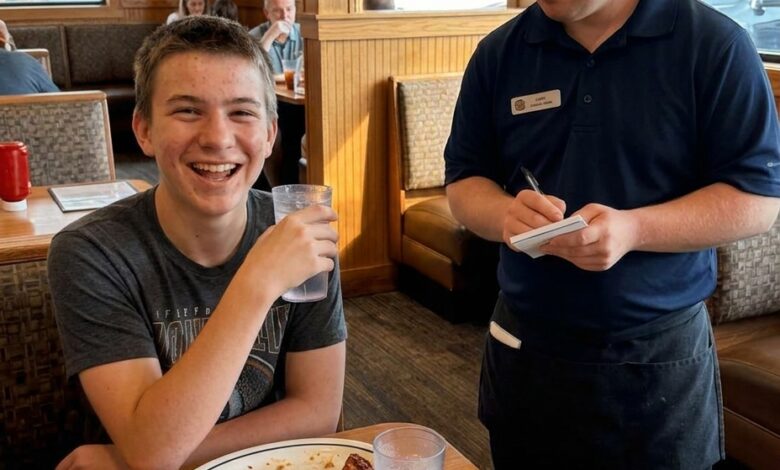
The moment my fourteen-year-old son imitated our waiter, the entire restaurant seemed to go quiet. Sam, a young man with Down syndrome, had just placed a basket of bread on our table after carefully reading the evening specials, and Leo waited until he turned away before copying his slow, deliberate speech and exaggerated walk. A couple beside us stared in disbelief. Another family stopped talking. Leo grinned as if he expected someone to laugh with him, but nobody did. I felt something worse than anger rise in me—shame. I paid the bill, left Sam a tip larger than the cost of our meal, apologized directly to him, and drove my son home without saying a word. Then I placed a dusty wooden box on the kitchen table and told Leo, “This is the biggest mistake I ever made.”
Inside were photographs, handwritten letters, an old basketball ticket and a green-and-white friendship bracelet I had not touched in nearly twenty years. The boy in the photographs was named Daniel. He had Down syndrome too, and when I was sixteen, he had been my closest friend during one of the darkest periods of my life. My father had just died, and while most teenagers around me had no idea what to say, Daniel simply sat beside me at lunch every day. He shared half his sandwich, remembered my favorite candy and told terrible jokes until I eventually laughed again. He never asked me to stop grieving; he just refused to let me grieve alone. At school, however, other students mocked the way he spoke and treated my friendship with him as something embarrassing. I told myself their opinions did not matter—until one afternoon, when the girls everyone wanted to impress saw Daniel walking toward us across the parking lot and began making cruel jokes. Daniel smiled when he spotted me. Then, instead of defending him, I laughed with them.
It lasted no more than two seconds, but Daniel heard me. I watched the smile disappear from his face before he turned around and walked away without saying anything. When I returned to school Monday hoping to apologize, he was absent. He did not come Tuesday or Wednesday either. Then I learned that his mother had accepted a job in another state and they had moved over the weekend. Daniel left behind one letter for me. Leo unfolded the yellowed paper and read the simple words thanking me for being his friend and wishing that I would “smile lots.” I told my son that Daniel had written those words after hearing me betray him. Leo looked down at the table and whispered that what happened at the restaurant had only been a joke. “So were those girls,” I said. “They probably forgot about it by dinner. Daniel didn’t. Neither did I.” That was when Leo finally began to understand that cruelty does not become harmless simply because the person delivering it is laughing.