I Worried My Brother With Down Syndrome Would Be Judged at Prom—Then He Opened the Box He’d Spent Five Months Building
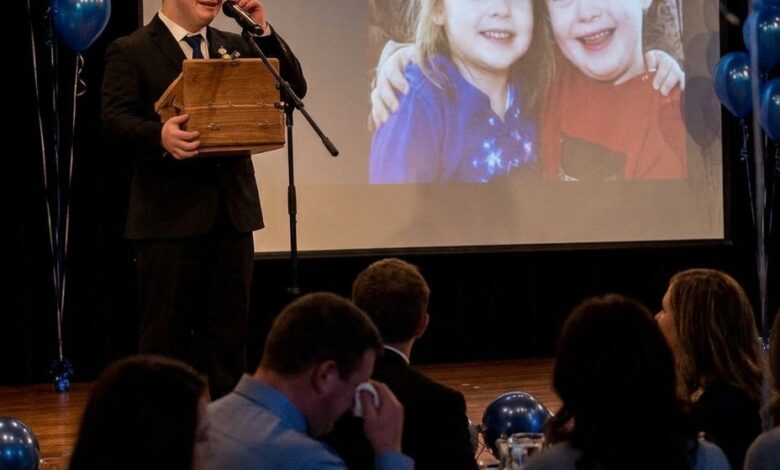
For one terrible second, I was still afraid when Danny reached into the wooden box under the stage lights. Four hundred people had gone quiet, and I could feel every eye on my younger brother as he stood at the microphone in his best clothes, glasses slipping slightly down his nose. I had spent months wondering whether the handmade gift he had prepared for me would look small beside the polished paintings, framed photographs and elaborate projects other siblings had brought for prom night. Then Danny pulled out a crooked little wooden sparrow with uneven wings and a beak tilted slightly to one side. I knew it immediately. Our grandmother had called me Sparrow when I was little, and Danny, before he could pronounce the word properly, had called me “Pah-row.” He looked at me and asked, “You know it?” By the time I nodded, my hand was already over my mouth.
The sparrow was only the beginning. Danny had been working since January in our garage with Mr. Alvarez, an eighty-two-year-old retired carpenter who lived four houses down and handled the dangerous tools while Danny did most of the designing, cutting, sanding and wood-burning himself. From the box came a wooden key because, as Danny explained, I “open things people don’t say,” a reference to the months after our father died suddenly of a heart attack when I had pushed our grieving mother to talk to us instead of disappearing into silence. Then came a tiny wooden ruler because I measured everything—grades, calories, running miles, study hours and every other number I could use to decide whether I was good enough. Danny stared at that ruler, announced that he did not like it, and snapped it in half in front of the entire room. The laughter and applause that followed were warm rather than cruel, and something in me began to loosen. He brought out a small piano next, reminding me that I had quit lessons at fifteen after making three mistakes in a recital. “You were still good,” he said simply. I had spent years forgetting that. Danny had not.
Then came the object that cracked me open. Danny lifted a tiny wooden book representing college and proudly announced that I had been accepted to Northwestern. Everyone expected me to go five hours away, and I expected it too, because prestige and opportunity had become part of the measuring system I used for my life. Danny looked at me and said, “You can go.” Then he added, “You can come back too.” After that he placed a small wooden house on the table with four names burned into its side: Mom, Danny, Marianne and Dad. Our father had been gone for years, but Danny explained that he was “still in it.” Finally, Danny turned the empty box around and revealed words carefully burned into the inside of the lid: MARIANNE IS NOT THE BEST BECAUSE SHE IS FIRST. SHE IS THE BEST BECAUSE SHE COMES BACK. He reminded me of the fair where he got lost and I came looking, the surgery I left a debate tournament to attend, the difficult months after Dad died, and all the ordinary times I had gone away and returned. I had spent the entire evening worrying that people might judge the uneven cuts in his gift. Instead, Danny had spent five months building a map of my entire life.