My Mother-in-Law Charged Us $209 After Begging for a Weekend With Our Daughter—So We Paid Every Cent and Changed the Rules
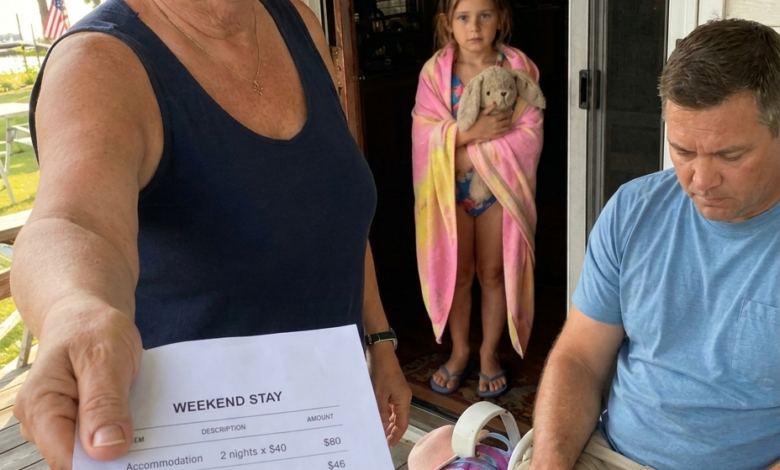
My mother-in-law was waiting on the porch when we arrived to pick up our six-year-old daughter, Ellie, from her first weekend away from us. Ellie came running outside in her swimsuit with a towel over her shoulders, thrilled about boat rides, juice boxes, and a heron she had spotted near the dock. Then Diane handed my husband Marcus a typed sheet of paper and said, “Don’t panic. It’s just so everything’s transparent.” At the top were the dates of Ellie’s stay, followed by itemized charges: $80 for two nights of accommodation, $46 for groceries, $9 for sunscreen, $7 for juice boxes, $30 for boat fuel, $15 for laundry, and $22 for electricity and water. Total: $209. Diane had spent four months asking us to let Ellie stay at her lake house, yet suddenly she was describing the visit as though we had hired her for a weekend. What bothered me most was not the amount. It was seeing Ellie standing in the doorway, clutching her stuffed rabbit, after hearing her grandmother say, “That’s what Ellie costs.”
Diane had wanted this weekend badly enough to bring it up at nearly every family gathering since spring. Ellie had never slept away from Marcus and me before, and I was the reluctant one, while Marcus kept reminding me that his happiest childhood memories came from summers at that lake. Eventually I agreed. I packed Ellie’s clothes, swimsuit, inhaler, sun hat, and favorite rabbit, wrote out medication instructions, and hugged her until she laughingly complained she couldn’t breathe. During the weekend, Diane sent photographs and Ellie called twice sounding delighted, which finally convinced me that my anxiety had been unnecessary. Then came the invoice. When Marcus reminded his mother that she had been the one asking for the visit, Diane insisted she was retired and should not be “out of pocket” because we had supposedly wanted a weekend to ourselves. Ellie later asked me quietly in the car, “Did I do something bad?” That question was when the issue stopped being about money at all.
That night I considered sending Diane an invoice of my own—transportation, packing, preparation—before realizing I would simply be playing the same game. Instead, I transferred the entire $209 the next morning and sent her a written response. Payment enclosed in full, it said, but because she had chosen to treat time with Ellie as a reimbursable expense, there would be no more overnight visits or unsupervised babysitting for the time being. We would never again place her in a position where she could spend money on Ellie and later decide we had incurred a debt, and there would be no conversations within Ellie’s hearing about what her presence “cost.” Diane called eleven minutes later, furious that we were keeping her granddaughter away over $209. Marcus surprised both of us by backing the boundary without hesitation. When we explained that Ellie had heard the invoice discussion and believed she had done something wrong, Diane finally became quiet. Her intention, she said, had never been to make her granddaughter feel unwanted. But intention was no longer enough; the effect had already reached a six-year-old who could not distinguish a household-expense estimate from a judgment about her value.