I Adopted Two Baby Boys Left on My Doorstep—Twenty Years Later, They Told Me Who Had Really Put Them There
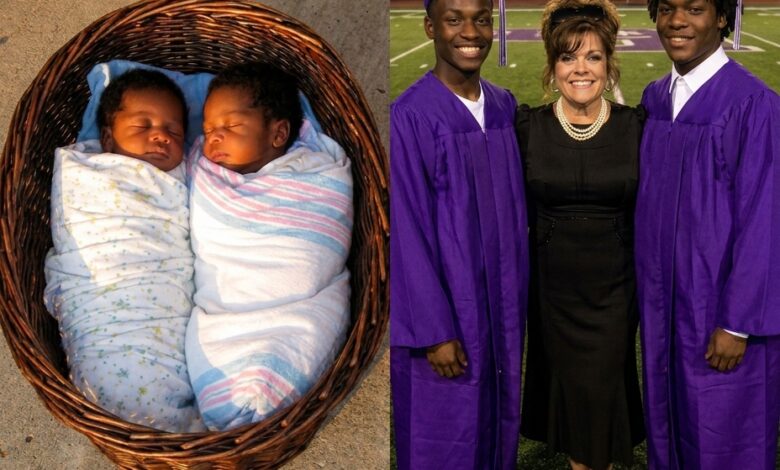
The wicker basket sat in the middle of my dining table like something dragged out of another lifetime. One broken reed still curled near the handle, and the faded blue lining was exactly as I remembered it from the morning, twenty years earlier, when I had found two crying babies inside. My grown sons, Caleb and Noah, sat across from me with untouched plates and expressions that made my stomach tighten. “Mom,” Caleb said carefully, “please don’t leave us for what we hid from you.” Then Noah told me Raymond—the man who had been my closest friend for decades—had given them the basket. I could barely hear the rest over the pounding in my ears. There had been no anonymous mother abandoning twins on my porch, they said; Raymond had arranged the entire thing.
Years earlier, infertility related to my dwarfism had ended my marriage when my husband Ben decided I could not give him the family he wanted. Raymond appeared that same night carrying two pizzas and quietly helped me survive the wreckage, then stayed beside me while I rebuilt my life. A year later, I opened my front door and discovered two infant boys wrapped together in that basket, with no note and no apparent trace of their mother. Police investigated, the babies entered foster care, and I tried to walk away from the story—but I could not stop visiting them. When I finally told Raymond I wanted to adopt both boys, he helped me complete the paperwork, drove me to every court appearance, held my hand outside the judge’s chambers and promised he was not going anywhere. Judge Marsh eventually approved the adoption, and Caleb and Noah became mine. For the next twenty years, Raymond remained beside us through birthdays, broken bones, school plays, driving lessons and college acceptance letters, while I continued calling his devotion friendship because I had never allowed myself to look at it more closely.
The truth my sons carried was far more complicated. Raymond had privately worked with a surrogate and agency after learning that I could not carry a child, paid the expenses from his own savings and arranged for the twins to enter the legal foster-care process before appearing on my porch. According to Caleb and Noah, he had staged the discovery because he knew I would refuse anything that felt like charity or obligation. He wanted me to decide for myself whether I wanted those babies, without knowing he had created the opportunity. Raymond had kept the basket afterward and finally told the boys the truth two months before that dinner because he believed they deserved to know where their story began. My first reaction was fury—not at Caleb and Noah, but at the man who had quietly altered the course of my life without my consent. Yet beneath the anger was the unbearable realization that nearly every memory of raising my sons now contained Raymond somewhere in the background.