My Mother-in-Law Served Me Divorce Papers at the Army Ball—Then Her Own Words Became Evidence
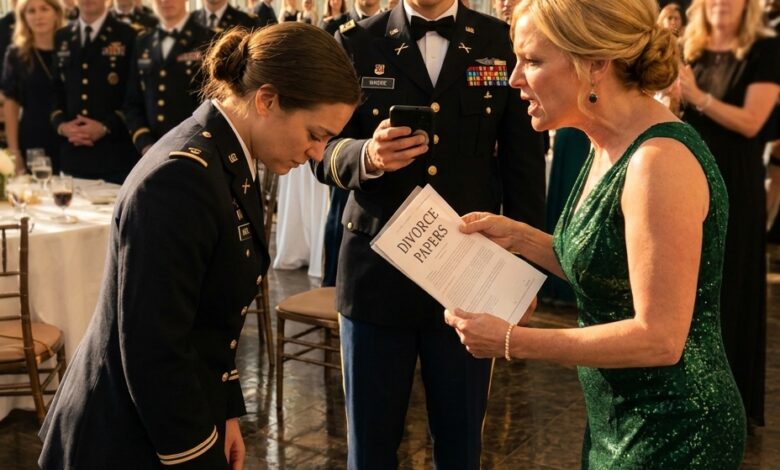
Diane Keller waited until the band stopped between songs before crossing the ballroom in a navy sequined gown and placing a cream envelope beside my plate. “Happy birthday, Natalie,” she said, smiling as though she had brought me a gift instead of divorce papers. Ten feet away, my husband Grant held up his phone and filmed me while officers from my unit sat in stunned silence around the table. I opened the envelope and found a petition demanding possession of our home, division of our accounts, and reimbursement for improvements to the Raleigh house my grandfather had left me before the marriage. Grant laughed and told me to sign. I calmly signed the acknowledgment of service—not the settlement—then stood and thanked him for serving me in front of eighty-seven witnesses while recording his mother explaining what they intended to do with my property. His smile disappeared just as the ballroom doors opened and Detective Rebecca Shaw walked in beside two uniformed officers.
Three weeks earlier, my bank had alerted me to a $186,000 home-equity transaction tied to that inherited house. I had never authorized the loan, yet the paperwork carried what appeared to be my signature, along with a deed supposedly transferring half the property to Grant. Years earlier, before a deployment, I had given him a limited power of attorney, but it had been formally revoked two years before the transaction. Rather than confront him, I contacted my attorney Claire Morgan, the bank’s fraud department and Wake County investigators. They traced $94,000 of the borrowed money into Diane’s account, another $42,000 into Grant’s failing renovation business and roughly $31,000 toward credit-card debt. Claire already knew Grant planned to serve me publicly at the ball and had attended as my guest. What Grant and Diane had not anticipated was that the spectacle they staged would give investigators a room full of witnesses—and a recording made by Grant himself.
The divorce filing contained another surprise: a postnuptial agreement supposedly signed eighteen months earlier in which I had allegedly converted my inherited house into marital property and waived claims against debts Grant created. I had never seen the document. Diane’s sister Elaine was listed as the notary, but security footage from the date of the supposed signing showed Grant and Diane entering Elaine’s office while I was hundreds of miles away training at Fort Irwin. Then Rebecca revealed the document’s digital metadata showed it had actually been created the day before the Army Ball, after Grant’s attorney demanded proof that the agreement existed. Diane’s face changed for the first time that evening. Then, forgetting how many people were standing within earshot, she whispered to Grant, “You told me nobody could trace that.” The performance ended in that single sentence.