My Son Mowed Our Elderly Neighbor’s Lawn for Four Years—Then a Lawyer Found Him at the Funeral
The lawyer walked the entire length of the church aisle and stopped in front of my son Noah, who had deliberately chosen the last row so he would not intrude on Mr. Vance’s family. He opened a leather document case, removed a thick cream-colored envelope sealed with wax, and held it out with both hands. “He left very specific instructions for you,” he said. Noah looked at me, then back at the envelope, clearly trying to understand why an estate attorney would be seeking out an eighteen-year-old boy at a funeral. Across the church, Mr. Vance’s son Richard watched with an expression that told me he already knew what was happening. Noah accepted the envelope, but he did not open it there. Forty minutes after we got home, he came into the kitchen with red eyes, unfolded a letter and told me that Harold Vance—the quiet old man across the street whose lawn he had mowed for free every Saturday for four years—had left him an $85,000 educational trust.
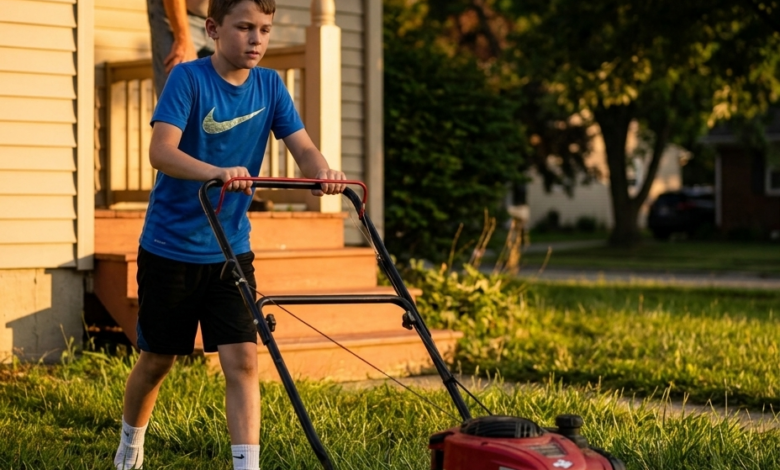
Noah had begun mowing the lawn when he was fourteen, after noticing Mr. Vance standing at the top of his driveway as though the short walk to the mailbox had become a calculation. Harold was already a widower by then; his wife Dorothy had died, his grown children lived elsewhere, and most days he sat in a green chair on his porch watching Clairmont Street pass in front of him. Noah never asked permission to turn the arrangement into something sentimental. He simply crossed the street with our mower one Saturday, rang the bell so Mr. Vance would not be startled, cut the grass and came home. Then he did it again the next week. Summer became fall, mowing became leaf-raking, spring brought the mower back out, and somehow the pattern continued through schoolwork, adolescence, heat, cold and four changing seasons. Mr. Vance rarely spoke. Sometimes he mentioned the weather; once he explained how to prune the roses Dorothy loved along the west fence. When I asked Noah whether the silence bothered him, he said something I never forgot: “He comes out to the porch every time. I think that’s him saying something.”
By the fourth year, Mr. Vance’s health had declined enough that he sometimes watched Noah through the window instead of from the porch. His son Richard eventually told me that his father spoke about “the boy across the street” more than he spoke about most things and valued the fact that Noah simply showed up. The formal letter from the estate explained how closely Harold had been paying attention. The $85,000 trust was restricted to accredited post-secondary education, including tuition, books and professional training, and would be administered through attorney Paul Eckhard’s office. But the handwritten portion mattered more to Noah. Harold wrote that he had watched him cross the street every Saturday without asking for money, praise or recognition, and believed that someone capable of that kind of consistency would be good at whatever he chose to do with his life. He wrote that Dorothy would have liked Noah because she believed you could judge a person by whether they noticed what everyone else overlooked. His last shaky line was about the roses: Tell him they need cutting back in February. He knows what to do.