At Six, I Promised My Best Friend We’d Go to Prom Together—Twelve Years Later, My Mother Stopped Me at the Door
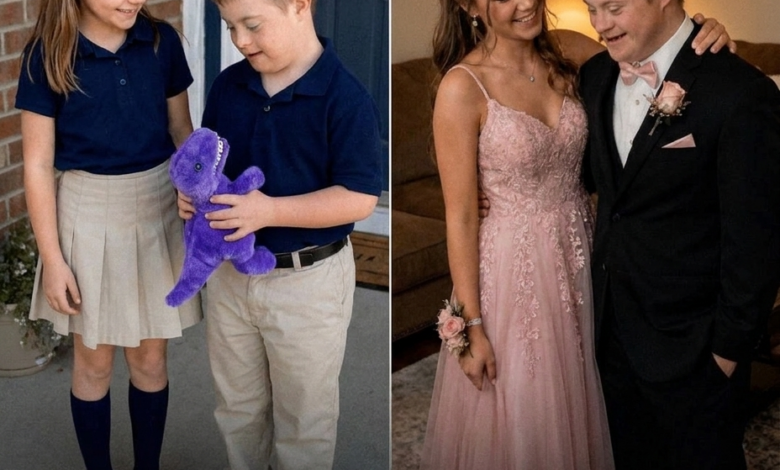
My mother locked my bedroom door on prom night while Noah waited downstairs in a navy suit, holding a rosemary corsage and wearing the bow tie he had bought four months early. I could hear him laughing with my aunt through the floorboards while Mom stood in front of me with trembling hands and said, “You can go with him tonight, Christina, but only on one condition.” For a second I thought she meant curfew, and then I saw the tears in her eyes. “You have to hear something first,” she said. “About Noah. And about me.” Anger flashed through me because Noah had Down syndrome, and I was suddenly afraid this was going to become one of those conversations where someone assumed I was doing him a favor simply by being his friend. Then Mom sat on the edge of my bed and said, “I owe both of you the truth.”
Noah and I had been best friends since first grade, when we discovered that we both considered raisins nothing more than “old grapes” and therefore unfit for human consumption. At six, another boy told Noah nobody would ever marry him, and when I defended him, Noah asked with painful seriousness whether I might love him someday. I told him maybe, then announced that first we would have to go to prom because, in my six-year-old mind, that was apparently the proper sequence of adult life. We sealed it with a pinkie promise. The promise itself faded from my memory, but Noah never forgot, and our friendship survived twelve years of separate classes, changing interests, adolescence and my parents’ divorce. When I stopped eating lunch after Dad left, Noah sat beside me without demanding explanations. When I failed my driving test, he brought two ice creams—one because I had tried and another because, according to him, I had driven terribly. When I wanted to quit painting, he taped my worst dinosaur drawing inside his locker and refused to remove it until my dinosaurs improved. He had never rescued me with speeches; he had simply developed an extraordinary talent for staying.
What I did not know was that during the worst year of my parents’ divorce, Noah had found my mother crying alone in her car outside school. He told her I had stopped eating, laughing and talking the way I used to, then asked whether I was “broken.” When Mom assured him I was not, he said something she had carried for six years: “Good. Because I don’t know how to fix people. I only know how to stay.” Desperate and overwhelmed, Mom asked twelve-year-old Noah to promise he would look after me, and he agreed without hesitation. But over the years she began interpreting our friendship through that promise. Whenever I waited for Noah, defended him when he was excluded or changed plans because he had not been invited, she worried I was sacrificing my own life out of responsibility for him. “I kept measuring the friendship by what Noah might need from you,” she admitted. “I never measured it by what he gives.” Suddenly the lunches, ice cream, terrible dinosaur drawing and quiet porch conversations rearranged themselves in my mind. Noah had never been a burden I was carrying; we had been carrying ordinary pieces of life for each other.