The New Food Pantry Volunteer Was My Son, Gone 15 Years — We Compared Phones and Found Who Built the Wall
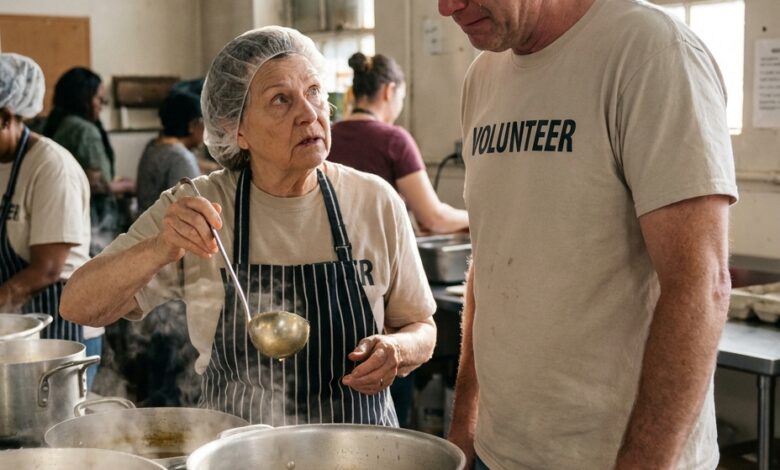
At 11:40 on a Tuesday morning, in the storage room of the Bridgeport Community Pantry, my son and I sat on stacked cases of canned corn and reconstructed fifteen years in ninety minutes, and the architecture of our separation turned out to have one builder. My sister Francine. Joel went to prison at nineteen — the crash, the ice, his best friend Petey in the passenger seat, a grief this family will carry forever and carried, for years, correctly: with visits, with letters, with a mother who drove four hours each way once a month. What I didn’t know was what happened when my health broke in 2015 — the winter of my heart surgery, the winter I missed three visits, the winter Francine volunteered to “handle communications” so I could recover. That was the winter the wall went up. Joel was released that spring. Francine met him at the gate — I never knew she went — and delivered my message: that my heart couldn’t survive the sight of him, that I’d asked for distance, that love meant vanishing. He was twenty-six, guilt-soaked, and fresh from a cell. He believed her. Of course he believed her. And then she came home and delivered his message to me: that he wanted to disappear, that contact would “pull him back under,” that if I loved him I’d let go. I was post-surgical and heartbroken. I believed her. Of course I believed her. Two believable lies, one each, custom-fitted — and then, for insurance, two phone numbers, each one digit wrong, so that even our disobedience would fail.
Why. That’s the question you’re asking, and I asked it at close range, at my own kitchen table, the following Sunday, with Joel parked around the corner because I wanted her answer before she knew the wall had fallen. I laid both phones on the table between the coffee cups, both wrong numbers displayed, and I said, “Francine. The pantry on Route 12 got a new volunteer this week. Tall. Petey’s laugh lines around his eyes now. Ladles soup like his grandfather.” And I watched my sister age a decade between sips of coffee. The answer, when it finally came out over that terrible hour, was smaller and older than I could have imagined, the way these answers always are: Petey — the boy who died in that car — was Francine’s godson. Her grief had nowhere to go in 2008, so it became a verdict, and the verdict said Joel didn’t deserve to come home to a mother’s table when Petey never would. She called it protecting me. She used those words at my table, fifteen years too late: “I was protecting you from having to choose.” From having to choose. As if a mother chooses. The warning signs I’d missed sat up and identified themselves: how Francine always changed the subject when I talked about hiring someone to find him; the year she talked me out of the private investigator — “let the poor boy be” — with $1,200 already saved in my dresser for it; how she was the only one of us who never once cried about Joel, not in fifteen years, because you don’t cry about a project that’s going according to plan.
What Joel built in eight quiet years, believing himself unwanted, is the part I need every mother in this audience to hear, because it broke me and remade me in one afternoon: a life. A real one. He finished his HVAC certification through a re-entry program. He’s a supervisor now — $31 an hour, he told me, with the shy pride of a man reporting to the only inspector who ever mattered. He married a woman named Carla who knows every inch of his story. And on the first Saturday of every month, for eight years, he has volunteered at a food pantry — a different one, until this month, when his regular pantry closed and the coordinator reassigned him to Bridgeport, forty minutes north, to a soup line next to a sixty-nine-year-old widow in a name tag. He also, I learned on those corn cases, did one more thing every year: he mailed a money order, anonymous, to Petey’s mother. Eight years. Every Christmas. She kept them in a drawer, uncashed, until two Christmases ago, when she finally wrote “STOP THIS. COME SEE ME INSTEAD” on the back of one and mailed it back to the return-address PO box. He went. They sat in her kitchen. Petey’s mother — the one woman on this earth with the standing to condemn my son — forgave him six years before his own aunt would have allowed him back at my table. She told him, he says, “Grief that locks doors isn’t loyalty to the dead, honey. It’s just grief with a hammer.”