A Probate Letter Arrived for a Name I’d Never Heard — My Husband of 41 Years Said “That Was Me”
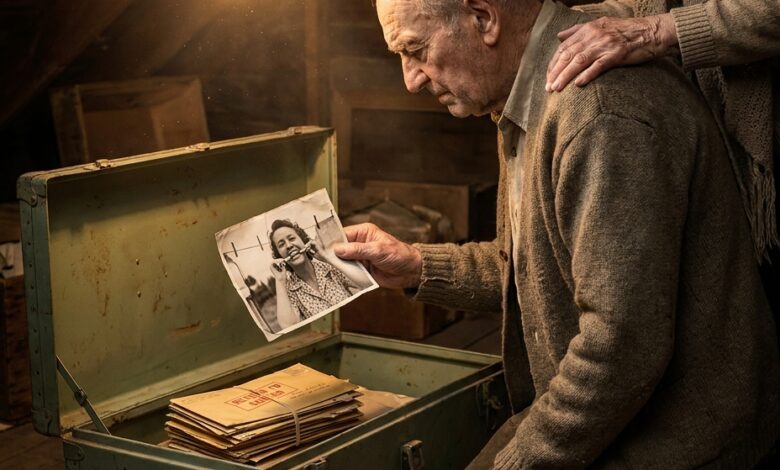
At 7:50 on a Tuesday evening I knelt with my husband on the plywood floor of our attic while he opened a green footlocker I had dusted around for four decades, and I am going to inventory it for you the way I inventoried it that night, because a man’s whole hidden boyhood turns out to be a short list. One photograph, black and white, of a thin woman laughing at a clothesline, wind in the sheets. One library card, county system, ANTHONY M. KOVACS printed in a boy’s careful hand. One bus ticket stub, one-way, dated March 3rd, 1973. One work shirt, folded, with KOVACS & SON COAL & HAULING stitched over the pocket. And a rubber-banded stack of envelopes — maybe thirty — every one addressed in the same feminine hand to “A. Kovacs” at a string of different addresses across three states, every one stamped RETURN TO SENDER — NOT AT THIS ADDRESS, every one unopened, every one, I realized as the dates climbed 1974, 1975, 1978, 1981, sent by someone who kept trying, and kept missing him, as a young man kept moving. Tom picked up the photograph of the laughing woman and held it under the attic bulb, and my husband of forty-one years said, in that voice from somewhere else: “Hi, Ma.” And then he handed me the envelopes and said, “She looked for me, Peg. I was seventeen and stupid and fast, and she looked for me, and I didn’t find that out until I stole these off my cousin’s porch in 1982 and couldn’t make myself open a single one. Because if they said she forgave me, I’d have to go back. And if they said she didn’t—” He stopped. Forty-one years, and I finally understood the sound our attic made in my imagination all those decades. It was a boy, holding his breath.
Here is the first seventeen years of Anthony Kovacs, as told to me between the attic and 2 AM at our kitchen table, and I will tell it the way he did — flat, factual, an old man handling hot iron with the tongs of plain speech. A coal-patch town outside Scranton. A father, Big Marek, who hauled coal sober and broke things drunk, and was drunk more, and whose rages the whole street could hear and the whole street ignored, because it was 1965, and 1968, and 1971, and that’s what streets did then. A mother, Lena, who worked the shirt factory and mastered the arts of that era — the long sleeves in summer, the “fell on the ice,” the shielding of the boy with her own body and her own excuses. The winter Tom — Anthony — was sixteen, his father broke the boy’s arm against a doorframe, and the county sent a man who took a report and shook Big Marek’s hand on the porch. And in March of 1973, seventeen years old, arm newly out of its cast, Anthony Kovacs did the arithmetic of the powerless: he could not beat his father, he could not move his mother — he’d begged her that winter, he told me, BEGGED, and she’d said the sentence that sent him down the road: “He’s my husband, Antek. Where would I even go?” — and so he saved eleven weeks of gas-station pay, bought a one-way ticket, and became, in a courthouse two states away at nineteen, Thomas Lawton, his grandmother’s good plain name. The car-crash orphan story came later, he said, “because dead parents end conversations, and mine were a conversation I couldn’t survive having.” The warning signs I’d filed away across four decades assembled themselves in that kitchen like witnesses: the way Tom left any room where a movie father raised his voice; his flat refusal, ever, to drive through eastern Pennsylvania — forty years of “there’s nothing on that route, Peg”; the long-sleeve shirts he wears every summer of his life; and his single strange constancy, the thing I’d always found sweet and never found curious — that every year on the third of March, my husband buys flowers, “for the kitchen,” and never says another word about it. The bus left on the third of March. He’d been leaving her flowers for fifty-three years.
The probate letter, when we finally read it properly at midnight, contained the death of Big Marek — ninety-four, outliving his victims’ patience if not their memories — and the small estate of a row house and a burial policy, with Anthony Marek Kovacs named by the court’s genealogist as sole surviving heir. Sole surviving. Tom read that phrase and his whole body sagged with a grief he had no right to expect, he said, after wishing the man gone for sixty years — “you mourn the father you should have had, Peg, the dead one finally makes room for him” — and then he reached the paragraph that undid the night entirely. The estate was small, the letter explained, because the decedent’s assets had been substantially reduced by a 1981 divorce settlement. Divorce. 1981. Tom stood up so fast the chair went over. She LEFT him. Eight years after the bus, his mother had done the impossible arithmetic after all — and the letter’s next line, in the dry language of probate lawyers, delivered the sentence my husband had waited fifty-three years to hear and never once dared check: “The decedent’s former spouse, Lena Kovacs Barna, is living, and is a resident of the Maple Run assisted living community. As she is not an heir, this office has no further obligation to her; however, she has asked this firm, on the occasion of each contact over many years, whether any inquiry has ever located her son. We are permitted to say that the answer we have long wished to give her is now, apparently, yes.”