I Called My Son-in-Law a Freeloader at Easter — A Misdelivered Letter Showed He’d Paid My Insurance for Six Years
At 9:47 on a Monday morning I stood in my kitchen with a phone in one hand and a misdelivered envelope in the other, listening to a stranger read me a message my son-in-law wrote six years ago for exactly this moment — “she’s sharper than she acts on the phone” — and I had to sit down on my step stool, because the last Thursday. I knew instantly which Thursday. My Hal died on a Sunday in March of 2020, at Fairhaven Hospice, and the last day he was fully himself — talking, joking, ordering everyone around from the bed — was the Thursday before. I spent that Thursday in the family lounge signing things and crying in the good way, and Hal spent a piece of it alone with the night CNA he’d gotten attached to, a quiet young man who worked the 7-to-7 and called him “boss” and was the only person on Earth who could get Hal to take his pills without a filibuster. The CNA’s name was Marco. That is how Marco entered this family — not as my daughter’s boyfriend, but as the man who kept my husband comfortable and laughing through his last winter. Dana met him in that hallway. They married two years later. And somewhere in eight years of Sunday dinners, I had managed to completely misplace that origin story — to reclassify the man from “the angel on nights” to “the quiet one who doesn’t provide” — because grief does something ugly to gratitude if you’re not careful with it, friends, and I was not careful with it. I was two glasses of wine not careful with it, in front of my grandchildren, at Easter.
Here’s the backstory I had built about Marco, and then the real one, so you can watch me be wrong in high definition. My version: Marco worked “some part-time warehouse thing” (he’s vague about work at dinner — humble, it turns out, reads as evasive if you’re determined to read it that way); he was home at odd daytime hours (night shift, Gail, you absolute cabbage — the man sleeps mornings because he works while the rest of us dream); Dana carried the household (they split it, I eventually learned, right down the middle, and his half arrived like a metronome); and the $15,400 — the two hundred fourteen dollars a month since March of 2020 — didn’t exist in my version at all, because in my version, the reason my supplemental insurance had “sorted itself out” during the worst year of my life was that Hal must have prepaid something, or the company had been decent, or God had. The truth: in early 2020, drowning, I’d missed three premium payments I have no memory of missing, and the policy — the one that would cover my hip replacement fourteen months later, the one that has since covered more than $60,000 of what Medicare didn’t — was eleven days from lapsing. I know this now because the young man on the phone read me the whole history. Somebody caught it eleven days out. Somebody set up the autopay from his own account “temporarily.” And then somebody, a CNA making a CNA’s wages, married into the family two years later and just… never turned it off. Never mentioned it. Sat across from me at eight years of dinners, passed me the rolls, absorbed “some men just attend,” and paid the premium on the first of every month like a heartbeat.
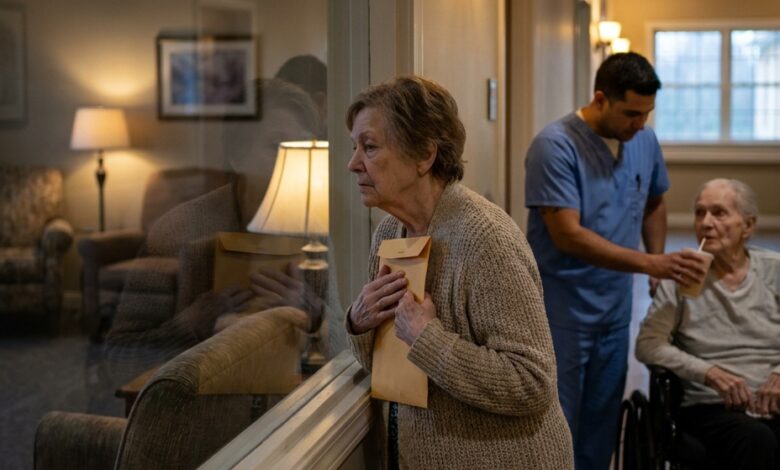
I did not call Dana. This one couldn’t go through the switchboard. Tuesday at 6:40 in the evening I drove to their house to catch Marco before his shift — I knew his schedule now, I’d asked the one question I should have asked years ago — and Dana answered the door and said he’d already left for work, and I heard myself ask, casual as a heart attack, “Remind me where the warehouse is, honey?” and my daughter looked at me strangely and said, “Warehouse? Mom, Marco’s at Fairhaven. Where he’s always been. He’s senior CNA on nights now — he trains the new ones.” Fairhaven. He’d never left. For eight years my son-in-law had been doing, five nights a week, the thing he did for my Hal — the pills, the jokes, the 3 AM fears, other people’s last Thursdays — and I had translated that into “attends.” So I did the thing my pride would never have let me do a month earlier: I drove to Fairhaven Hospice at 7:30 at night, walked into that lobby I hadn’t entered since March of 2020, and asked the desk if I could speak to Marco Ruiz when he had a minute. And through the glass of the family lounge — the same lounge — I watched my son-in-law down the hall, sitting on the edge of some other family’s father’s bed, holding a cup with a straw at exactly the right angle, laughing at something the old man said. The desk girl followed my eyes and said, fondly, like it was the building’s open secret: “That’s our Marco. The families always ask for him at the end. He’s got a promise he makes them — I’ve heard him do it a hundred times.” I said, “What promise?” And she said, “He tells them: ‘Whatever you’re leaving unfinished, boss — give it to me. I’ve got strong hands and a bad memory for thank-yous.'” And the envelope in my purse got very heavy, and Marco looked up, and saw me standing in that lobby holding it — and he knew. I watched him know. He said something to his patient, straightened the blanket, and came down that hallway toward me, and the first words out of his mouth after six years of silence and fifteen thousand dollars were: