The Same Bouquet Arrived Every Year After My Husband Died — This Year I Saw the Invoice: “Order 4 of 20, Prepaid”
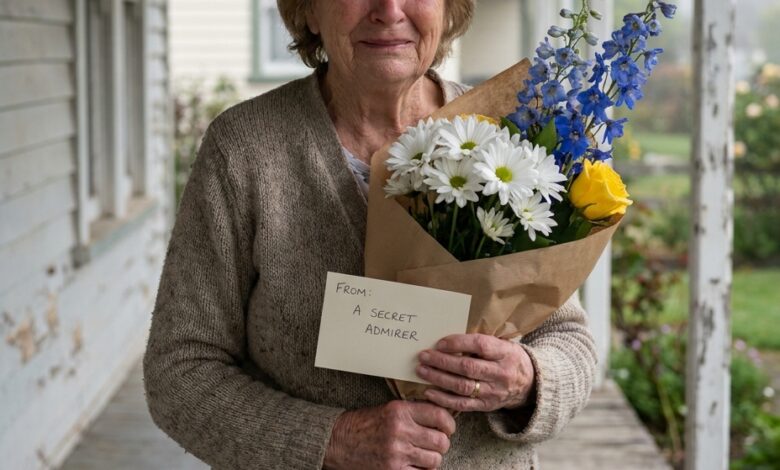
At 4:40 that afternoon I stood in my own kitchen with the freezer door open, cold rolling over my slippers, moving a 2019 pot roast I had apparently been guarding for six years — and there it was, exactly where the index card promised: a coffee can, the old Maxwell House kind, lid taped, wrapped in two freezer bags, labeled in marker: DO NOT THROW OUT, PROPERTY OF WILLIAM T. KELLER, YES JOYCE THIS MEANS YOU. I laughed out loud, alone, in front of an open freezer, because that label was forty-four years of marriage in one sentence — the man labeled everything, argued with me in writing on labels, and knew, KNEW, that in my grief I would clean out every drawer and closet but would never in a thousand years disturb the deep freezer, which was his territory the way the stove was mine. Inside the can, rolled in a rubber band: a life-insurance policy from 1991 I had never seen in my life, a savings passbook in both our names from a bank branch two towns over, and one more index card: “Now call Whitmore’s office. He’s expecting you, whenever this is. Sorry for the cloak and dagger, honey. I didn’t want you making any of these decisions the year I died. You always overwater the garden right after a storm.”
Let me tell you about the spring of 2018, which I have now had to completely re-live and re-understand. In February of that year, Bill got the diagnosis, and we did what our generation does: we told the kids the minimum, we kept our routines, and we were very brave at each other across the dinner table. What I didn’t know was what Bill’s “Tuesday coffee group” had actually become. The man was dying on a schedule, and he responded the way he responded to everything — he opened a project file. The florist, prepaid in cash from a passbook I never knew we had, so that (Wren showed me his instruction sheet, in his handwriting, laminated — HE LAMINATED IT) “the flowers must never depend on anyone’s memory, anyone’s marriage, or anyone’s opinion of what Joyce needs.” The policy from 1991 — bought, I pieced together, the year I had my scare, kept secret because “your mother panics about premiums” (he wrote that ON the policy, to our son, in the margin, in 1994). The warning signs I’d filed under nothing at the time: how that spring he kept “reorganizing” the freezer; how he made me promise, apropos of apparently nothing, never to switch florists “even when I’m too old for flowers, Joycie, ESPECIALLY then”; how he’d asked me that April, casual as a weather report, what I’d do with “a little extra someday” — and I’d said, not knowing I was being deposed, that I’d finally see the ocean from the other side, meaning the honeymoon we never took in 1974 because the transmission went out the same week as the wedding and the choice was Niagara Falls or a working car. He wrote my answer down. I know he wrote it down, because it was waiting for me at the lawyer’s office.
Whitmore — Bill’s attorney, semi-retired now, a man who has clearly been waiting eight years to make this phone call happen — sat me down that Thursday and opened a folder with my name on it, and the first thing in it was a letter that began: “Joyce. If Whitmore’s reading you this, you found the can, which means eight years went by, which means the flowers worked and you’re standing up straight. Good. Now don’t argue with the next part, I’m dead and I win automatically.” The room did not stay dry. The folder held the practical matter — the old policy, small but real, never claimed because never known, requiring some paperwork gymnastics this long after probate had closed — and the impractical matter, which was the point: an envelope marked NIAGARA, IN REVERSE, containing a hand-drawn map of the honeymoon route we never drove, researched in his hospital bed on the tablet he pretended to hate, with notes on which diners from 1974 were somehow still open (“the pie place survived, Joycie, it’s a Yelp thing now, 4.5 stars, we always knew”). And one instruction, non-negotiable, underlined twice: “Take the granddaughter. Nora drives too fast, which is correct for this trip.”