A Birthday Card in My Husband’s Blazer Said “61 Years, My Wednesday Girl” — We’ve Been Married 46
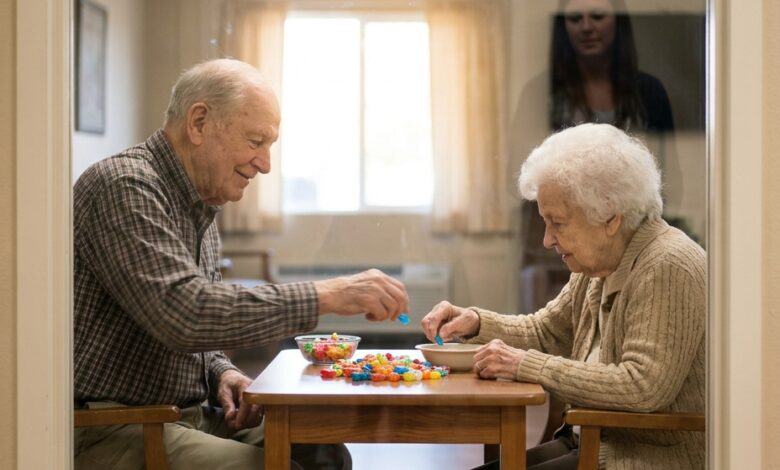
At 6:12 on a Wednesday evening I stood in the day room doorway of Maplewood Court Memory Care while an aide pressed into my hands a lumpy tissue-paper parcel labeled, in careful staff handwriting, FOR JOANIE — and my husband of forty-six years looked up from a table of sorted M&M’s and saw me, and I watched six decades of a secret land on his face all at once. He didn’t scramble. That’s the detail I keep returning to. Ed stood up slowly, the way he does for hymns, put one hand on the tiny white-haired woman’s shoulder, and said, “Greta, honey, look. Look who came. It’s Joanie.” And the woman — his sister, my sister-in-law, a person who had not existed at breakfast — looked at me with bright unfocused eyes and said, to the aide, in the loud whisper of the memory ward, “Is that the Joanie? The one Eddie made up?” The one Eddie made up. Because that’s what I had been, in this building, for years: a beloved character in the stories a devoted brother told on Wednesdays. And what Greta had been, in my house, for forty-six years, was nothing at all — not a name, not a photograph, not a ripple. Two women, each fictional in the other’s world, standing in a day room holding one tissue-paper parcel between them. Inside, when my hands worked again, was a potholder. Woven on a child’s plastic loom, in the crooked way of ninety-percent-gone hands, in one color. Every loop of it blue.
Ed told me the whole of it that night at our kitchen table, and I’m going to tell it the way he did — flat, chronological, no varnish, a man laying out evidence against himself. Margaret Voss Abernathy, called Greta, born 1949, four years older than Ed. A fever at eighteen months, in a farmhouse, in winter, a doctor who came too late — and a girl who grew up lovely and laughing and, in the language of that time and that county, “simple.” Ed’s father, a deacon with a public spine and a private terror of shame, managed it the way his generation managed it: in 1963, when Greta was fourteen and Ed was ten, she was placed in the state home at Fernbrook, three towns away, and the family story was installed by supper — Greta had “gone to live with an aunt in Missouri,” and by the next year, at the father’s decree, she wasn’t mentioned at all, and by the time Ed was in high school the neighbors’ memory had been successfully rewritten: the Abernathys had one child. His mother visited Greta in secret twice a year until her nerves “couldn’t take the drives.” His father never went once. And Ed — thirteen years old, three towns away from the sister who had taught him to fish and to lie about breaking the porch window — started riding his bicycle to the county line on Wednesdays after school, then the bus when he’d saved enough, to sit with Greta in a visiting room that smelled of bleach, sorting the candy he’d bought with pop-bottle money, because the blue ones had always been hers, since before the fever, a treaty older than the tragedy. He was ordered to stop. He said yes sir. He never stopped. Sixty-one years — the boy on the bicycle, the young man on the bus, the groom who came back from our honeymoon a day early “for a work thing,” the husband with the standing lodge night. There is no lodge. There was never a lodge. There is a sister, and there always was.
“Why didn’t you tell me?” is the question, of course — the one I asked at our kitchen table at midnight, the one every reader is asking. Ed took a long time, and when it came, it came in pieces, oldest first. His father had sworn him to silence with the specific cruelty of respectable men — told him at sixteen that if word got out, it would be Ed’s mother who paid for it in this town, Ed’s mother who’d be pitied at the church she lived for. Then his father died, and the silence should have died too, but by then Ed was courting me, and — he said this with his eyes on the table — “I was a twenty-six-year-old nobody asking the prettiest girl at First Methodist to marry a man with a good name, and the name was the only thing I had, and I was a coward, Joanie, and by our first anniversary the lie was load-bearing.” And then the years did what years do: every Wednesday made the next Wednesday harder to explain, until the confession he owed me had grown so large that handing it over meant handing me forty years of it at once, and he’d decided — this is the part that broke me, friends — that the honest math was to keep paying the debt himself rather than make me carry the discovery. The money I’d half-noticed for decades and filed under Ed being Ed: the part-time bookkeeping he kept until seventy, the “lodge dues,” the modest way we lived on two good pensions — all of it flowing quietly to Fernbrook until the state closed it in ’94, then to a group home, then to Maplewood when the dementia came for whatever the fever had left. My husband has spent, by his own careful ledger — of course there’s a ledger — a working man’s second lifetime on his sister’s care and never bought himself a new fishing rod in forty years. I sat at my kitchen table holding a blue potholder, married forty-six years to a man I’d just met, and I could not decide, at midnight, whether I was looking at the biggest lie of my life or the most faithful man I have ever heard of. It is possible, I have since learned, for both to be true. That’s the whole discovery. Both are true, every morning.