My Kitchen Tablet Chimed With New Family Photos — It Was My Daughter-in-Law Photographing a Guardianship Petition With My Name On It
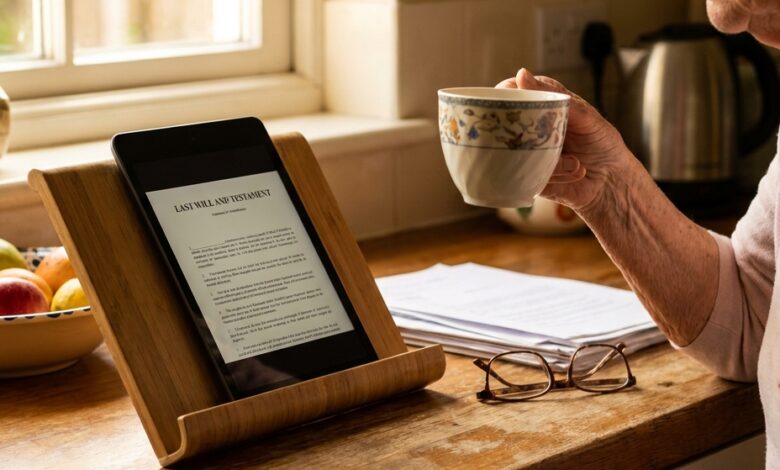
At 1:56 PM on a Tuesday I sat in my kitchen holding two screens: a tablet showing thirty rehearsals of my own forged signature, and a phone showing a text that said “Just us girls!! 💕” — and I understood, with a clarity I can only call cold, that Thursday’s “lunch” had a 10:00 AM appointment hidden inside it, and that I was scheduled to fail a test I didn’t know I was taking. I am seventy-four years old. I raised two boys, buried a husband, and kept the books for Walt’s plumbing business for twenty-six years, so let me tell you what I did NOT do, because it’s the most important paragraph in this story: I did not call anyone in my family. I did not confront, cry, or type one word into that chat. A woman who has seen a petition with her name in the incapacitated blank does not hand the petitioner a preview of her defense. Instead I did what bookkeepers do: I preserved the record. I photographed every image on that tablet with my phone — the petition pages, the Cedarbrook brochure with “house covers 4+ yrs” in Nicole’s handwriting, the practiced signatures, the appointment card, the upload timestamps, the little label that said “Nicole’s iPhone” — and I emailed the whole set to myself, twice, and then to my sister Ruth in Dayton, with a subject line I’d like on my headstone someday: “In case anyone ever asks whether I was sharp on July 8th.”
The backstory is money, and it’s short, because these stories always are once you find the number. My son Greg married Nicole four years ago — second marriage for both, and I welcomed her, I want that on the record too. My house is the number: paid off in 1994, appraised last spring (at Nicole’s helpful suggestion, “for insurance purposes, Mom”) at $410,000. Nicole’s boutique — a lovely shop, genuinely, I’ve bought scarves there — has been dying quietly for two years; I learned later the figure was $52,000 in merchant debt and a landlord out of patience. And for the past eighteen months, a story about me has been under construction, so gradual I mistook it for weather: Nicole announcing to rooms that I’d “told this story already, sweetheart” (sometimes true — I’m seventy-four, not a podcast); my reading glasses turning up in odd places I’d swear I never put them; the Sunday I was informed I’d called Nicole by the wrong name, an error I have no memory of making, which — I now understand — was the point of choosing errors that leave no evidence. The masterpiece was my own son’s face slowly changing as the story was installed in him: Greg started phoning me with a new voice, the slow loud kind, checking whether I’d “eaten something today, Mom.” I had eaten something today for seventy-four consecutive years. But I heard the worry in him and I knew it was real — that’s the cruelty of this particular con. The worry is genuine. Only the evidence is manufactured.
Wednesday — the day between the chimes and the “lunch” — was the busiest day of my retirement. At 9:00 AM I was in the office of an elder-law attorney, a brisk woman named Deborah who looked at my photographed file for a long four minutes and then said, “Mrs. Fowler, I want you to hear this clearly: you are about to have one of the easiest cases I’ve handled all year, because your daughter-in-law has photographed her entire plan and hand-delivered it to you, with timestamps, from her own phone.” By noon we had executed the armor: a fresh durable power of attorney and healthcare proxy naming my sister Ruth, revoking anything that might exist that I hadn’t knowingly signed; an updated will; and — Deborah’s centerpiece — an appointment that same afternoon with MY physician of nineteen years plus a geriatric specialist she trusts, for a full, formal cognitive and capacity evaluation, requested by me, on my own initiative. I spent ninety minutes drawing clocks, counting backward by sevens, recalling word lists, and explaining current events, and I will confess to you that I studied the night before like it was the SATs, which the specialist found very funny and also, she said, “extremely typical of the completely intact.” The letter she signed is two paragraphs long and it is the most beautiful thing I own: full capacity, no impairment, evaluation self-initiated. “Now,” Deborah said, sliding it into my file next to the practiced signatures, “let’s talk about Thursday. You have a lunch date. I’d like you to keep it.” <!–nextpage–>