My Family Left Me at a Highway Rest Stop and Texted “We’ll Grab You Sunday” — The Wedding Was Saturday
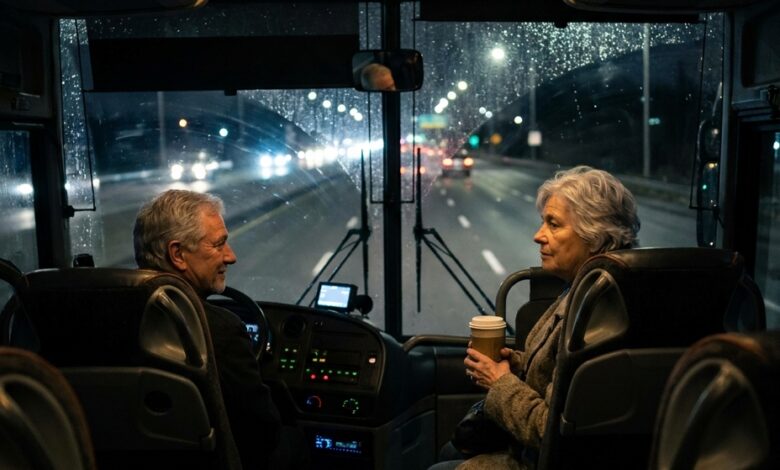
At 7:15 that Friday evening I climbed the steps of an empty 56-seat charter bus in a travel plaza parking lot, carrying my purse, a to-go cup of fresh coffee Reyna pressed on me, and a foil-wrapped slab of meatloaf “for the road,” and I sat in the first row behind a driver named Earl Dozier while the Route 30 plaza — the place my family had assigned me until Sunday — shrank away in the big mirrors. Earl had been scheduled to drive that bus empty, “deadheading,” to a depot forty minutes from Millbrook, and when Reyna explained the situation he’d said exactly one sentence about it: “Ma’am, I’ve been driving forty-one years, and I have never once been too full to carry somebody’s grandmother.” He talked to me the whole way — grandkids, knee replacements, the string of towns going by in the dark — and I understood he was doing it on purpose, keeping my mind on the road instead of on the van, and somewhere around the county line I stopped rereading Doug’s text and started composing what I would do, which is a much better use of a highway. By 10:40 PM I was at my sister Carol Ann’s door with meatloaf foil in my purse, and when she opened it and saw me — me, standing alone in the porch light, no van, no son — my baby sister took one look at my face and said, “Lorrie. Who do I need to kill.” Weddings bring out the truth in families. Sometimes a whole day early.
Here’s the backstory, and I’ll be fair to it, because fair is what I have instead of naive now. Shannon and I have never fit easy — I talk when I’m nervous, she goes silent when she’s angry, and a minivan makes a bad container for both. This trip was strained before the first fuel stop: money was tight and known to be — Doug got passed over for a promotion in March and they’d sunk $9,000 into a kitchen remodel anyway; the twins are fifteen and travel like a lit fuse; and Shannon had made it clear, in the way she makes things clear, that attending “another Fitch-side event” was a favor being deducted from some account I’ve never seen the statements of. The warning signs I’d waved off started that morning: my suitcase loaded last, “so it’s easy to grab”; Shannon plotting the route on her phone and announcing we would NOT be stopping at the outlet mall I like, before anyone had asked; and at the previous fuel stop, the twins staying in the car with the doors shut while Doug pumped gas and Shannon spoke at him through the window with a stillness I now recognize as a verdict being delivered. I found out later — from my grandson, weeks later, who told me because fifteen-year-olds are made of guilt and honesty in equal parts — that the decision at the Route 30 plaza took under a minute. He told me his dad sat with his hands on the wheel while the van idled, and said, “She’s going to be standing there with her coffee,” and Shannon said, “Then she’ll have coffee,” and my son — my son — put the van in drive.
Saturday at 3:20 PM I walked into the Millbrook chapel early, in a dress of my sister’s that fit like an apology, and Becca — the bride, my niece, who’d heard the whole story at breakfast — took my arm and personally seated me front row, left side, next to Carol Ann, in the seat reserved for family who matter. At 3:50, Doug, Shannon, and the twins came through the doors in their wedding clothes, fresh from the hotel they had driven to after leaving me — and I will remember until my last day the physics of my son’s face when he scanned the front row and found his abandoned mother already seated, already welcomed, one row closer to the altar than his own family’s seats. Shannon stopped walking entirely. An usher — nineteen years old, magnificent, no idea what he was in the middle of — checked his list and said the sentence God himself wrote for that boy: “Fitch? You’re mid-chapel on the right, we had a change — family seating got rearranged this morning.” Rearranged. By the bride. Who then, at the reception, during her welcome toast, raised her glass and said, “Before anything else — Aunt Lorrie, everybody. Some heroes drive buses.” And two hundred people applauded a story most of them didn’t know yet, and my son went the color of the tablecloth, and Shannon studied her bread plate like it was scripture, and I just smiled and waved, because I had decided on that dark highway exactly how this would go: I would not raise my voice. I would simply be visible, everywhere, radiantly fine, and let the story do its own driving.