A Waitress at a Highway Diner Had My Granddaughter’s Birthmark — She “Ran Away” 3 Years Ago. She Was Driven to a Bus Station.
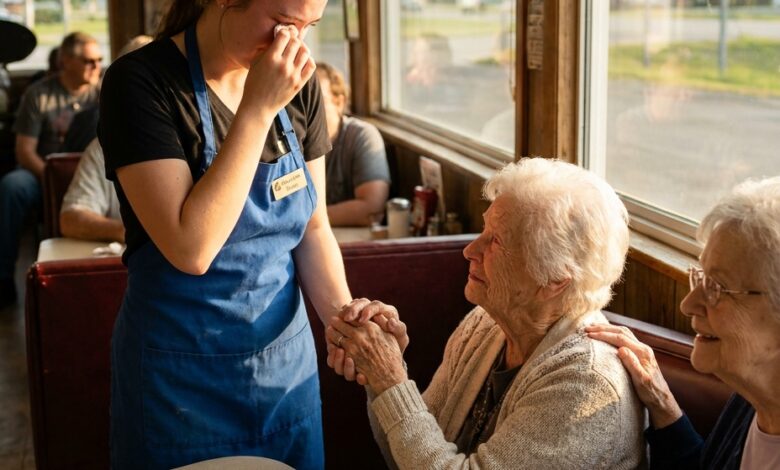
Three hundred miles from home, at a highway diner outside Marion at 1:40 on a Tuesday, the waitress set down my meatloaf and I saw her wrist: a crescent-moon birthmark below the left thumb — a birthmark I kissed when it was three hours old. Past the tired eyes, past the name tag reading “JO,” past brown hair that used to be blonde, I was looking at my granddaughter Josie, who “ran away” three years ago at sixteen and left behind a note — typed, which I always thought was strange — and a stepmother, Carla, who sighs at every holiday: “We gave that girl everything, and she chose the street over us.” Josie went white as the napkins and whispered, “Table six. Please don’t make a scene. I get off at 3.” My sister — 79 years old, five-foot-nothing, riding with me to her cardiology appointment — read my face, put on her glasses the way she does before a fight, and told the waitress we’d also be needing pie, because we were going to be there a while. And at 3:05, in the last booth by the window, my granddaughter shredded a napkin and told me what actually happened three years ago: she didn’t run. She was driven — to a bus station, at night, by Carla, eleven days after her sixteenth birthday, with two duffel bags, $200, and a speech: your father agreed this is best; you’re a disruption to this family; contact anyone and I’ll tell them what you did, and who do you think they’ll believe?
What Josie “did” was a lie with a receipt. That spring, Carla’s gold bracelet had “gone missing” and surfaced at a pawnshop; Carla produced the ticket, tearfully, with Josie’s name misspelled on it in handwriting nobody examined, and a police report was “filed” — waved around, never shown — while my son Danny, whiplashed between his new wife’s tears and his teenager’s denials, did the thing weak moments do and split the difference: no charges, but no trust either, and a house that went cold around a sixteen-year-old until she was easy to disappear. The typed note materialized on Josie’s pillow the morning after the bus station. And the architecture had one more load-bearing lie I only learned in that booth: eight months in, Josie called home once — one call, gathering three months of courage — and Carla answered, and told her that her father was standing right there and didn’t want to talk to her. Josie could hear the TV. She hung up and never tried again, because if HE didn’t want her… My son never knew about that call. For three years, Danny grieved a daughter who chose the street, Josie grieved a father who closed the door, and one woman built both griefs and lived warm in the space between them — redecorating, I might add, a bedroom she called “finally, my office.” I took my granddaughter’s hands across the table — a burn scar on one now, from three years of kitchens I will spend the rest of my life not thinking about — and offered her my guest room, my church lawyer, and my nothing-left-to-lose. And Josie shook her head, because the fence Carla built still stood: “Grandma, Carla keeps things. She has papers. The police report about the bracelet—”
That is when my sister leaned over the pie and said the sentence that started the war: “Sweetheart, I’ve known Carla Boyd since she was Carla Kowalski from Delancey Street. And there’s something about that woman your grandmother and I know that she doesn’t know we know. Get in the car, baby. It’s time she found out who she pawned.” Here is what we knew: forty years ago, my sister worked intake at the county courthouse, and Carla Kowalski’s first husband — a story Carla tells as “my tragic starter marriage” — had divorced her over what the filings politely called “financial misrepresentations,” including a pawned wedding set she’d reported stolen. Patterns, my sister says, are just crimes with seniority. So we did not storm home to a confrontation; we drove home to an audit. The church lawyer, a family-law attorney named Mrs. Adeyemi, took Josie’s statement that Friday, gently, with lemonade. The pawnshop — pawnshops keep records for a decade, and their cameras’ hard drives longer than anyone admits — produced the original ticket and, after a subpoena, the counter footage from that spring: a blonde woman in sunglasses pawning a gold bracelet, wearing a coat that still hangs, this year, in my son’s front closet. The “police report” turned out to be a case number for a call that was never converted into a report — Carla had called the non-emergency line, obtained a reference number, and let its official-sounding digits do three years of fencing. And the phone records Mrs. Adeyemi pulled for the custody-fraud file showed the eight-months-later call, four minutes long, on a night my son’s own work schedule — he drives regional freight — placed him four hundred miles away in Toledo. Nobody was standing right there. There was never anybody standing right there. When the folder was complete, Mrs. Adeyemi asked Josie how she wanted her father to learn the truth, and my granddaughter, nineteen now, with a spine three hard years wide, said the thing I’ll be proud of until they close my eyes: “In person. From me. With the folder on the table. He believed paper over me once — this time the paper’s on my side.”