Nine Days Before the Wedding, a Consignment Shop Called: My Mother’s 1962 Dress Was on Their Rack for $3,800
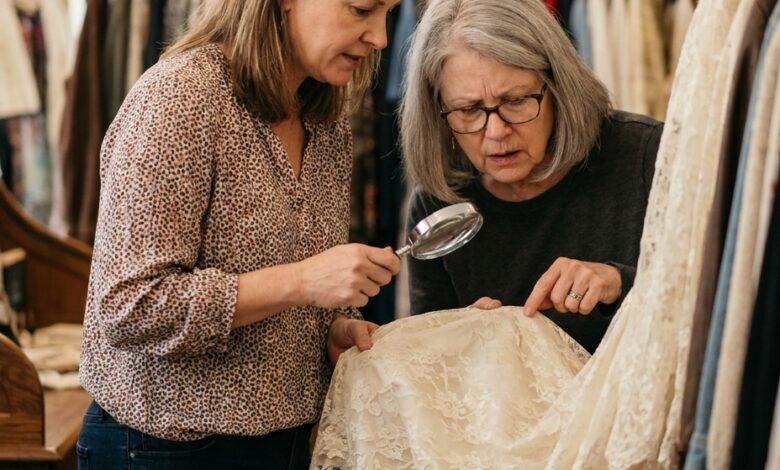
The call came nine days before my daughter’s wedding, at 2:15 on a Tuesday, from a consignment boutique on Fairview I’d never set foot in. The owner had taken in an ivory 1962 wedding gown the day before — hand embroidery, cathedral train, “estate piece,” priced at $3,800 — and while checking the interior seams for damage, she’d found a name stitched into the bodice: Margaret Ellen Doyle, June 1962. My mother’s name. My mother’s dress — the one she married in, the one I married in, in 1989, and the one my daughter Katie was to marry in, in nine days, after her future mother-in-law Vivienne had insisted, with silver-bobbed graciousness, on taking it to “her preservation specialist” for cleaning and fitting three weeks ago. The specialist updates had arrived like clockwork: they’re being very careful with the beading, darling; you’ll have it the Monday before. The dress was not with a specialist. The dress was on a rack between somebody’s fur coats, and the woman who’d left it was due back Thursday to sign the consignment agreement and deliver, quote, matching accessories — which meant my mother’s veil, my daughter’s something old, was scheduled for liquidation before the rehearsal dinner.
The shop owner’s name was Priya, and she did two things in that first phone call that I will be grateful for until they embroider my own name in a seam somewhere. The first was legal and swift: she hadn’t signed Vivienne’s consignment agreement yet, which meant the dress was, in her words, “just a dress a stranger left in my shop,” and she wanted its actual owner to come collect it that afternoon, before Thursday. The second thing was the reason I sat down on my stairs. “Ma’am, when women sell things that aren’t theirs nine days before a wedding, there’s always a why — and she told me a story yesterday I think you need to hear.” Because Vivienne, making elegant small talk over the dress, had explained to this total stranger that she was “consolidating some pieces” to cover “an embarrassing shortfall with the venue people,” who were “being rigid about the final payment.” The venue. The final payment. The payment that Vivienne — who had announced her “contribution” at the engagement party with a raised glass, who had insisted the venue and caterer contracts run through her “because I have relationships, darling” — had assured the children was made in full two months ago. My daughter’s wedding was nine days away, and its foundations, I suddenly understood, were made of the same material as the preservation specialist.
I collected the dress that afternoon — Priya had it boxed in acid-free tissue, refused the reward I tried to press on her, and photographed the intake form and Vivienne’s ID copy “in case anyone ever needs boring paperwork,” said with a look that told me she knew exactly what she was handing me — and then I spent one evening doing what mothers of brides do best, which is working a telephone with terrifying politeness. The venue confirmed it: final payment of $14,200, due in nine days, unpaid, with two “declined card” attempts on file from the previous month. The caterer: $6,800 outstanding, contract holder V. Ashford, one bounced deposit check quietly made good in cash. The photographer had been paid — by my son-in-law-to-be himself, I learned, because Vivienne had told the kids that vendor “preferred dealing with the groom.” Every thread led the same direction: Vivienne had promised a wedding she could not fund, spent months rerouting contracts to hide it, and, when the walls closed in, had priced my mother at $3,800 to buy herself two more weeks of the performance. I did not call her. Instead, on Wednesday night, I invited the children — just the children — to my kitchen table, laid out the dress box, the venue statement, the caterer’s ledger, and Priya’s intake form with Vivienne’s ID stapled to it, and let my daughter and her good, stunned fiancé Daniel read in silence. Daniel got to the ID copy, put both hands flat on my table, and said, very quietly, “Margaret, my mother did this to my father for thirty years. I swore she’d never do it to Katie. Will you help me end it before Thursday?” So Thursday at 2:00, when Vivienne swept into the boutique on Fairview with the veil in a garment bag, Priya greeted her warmly, stepped into the back “for the agreement” — and sent out, instead of paperwork, her other Thursday appointment: me, Daniel, and the dress box, sitting where the fur coats used to be.