The Dean Pulled Me Aside 40 Minutes Before My Granddaughter’s Graduation — Her Tuition Vanished at Her Stepfather’s Address
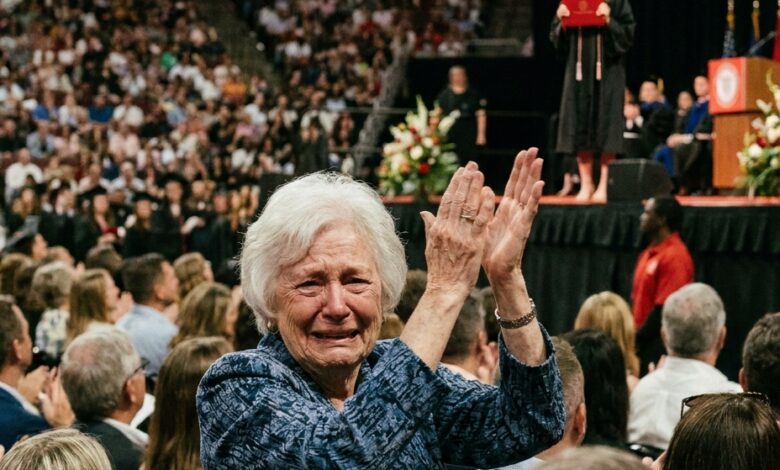
The woman from the registrar’s office found me in the arena crowd at 9:20, forty minutes before the processional, and asked me to come quietly — there was a problem with my granddaughter’s degree. In the administration office, the dean of students slid a printout across the desk: the tuition account I had funded for four years was $37,000 in default; no payment had reached the university in two years; Jenna could walk today, but her diploma folder would be empty and her transcript frozen. I told him that was impossible — eight semesters, $4,600 at a time, I had sold my lake lot to fill that account — and he turned the printout around and showed me where my money had been going instead. Two years ago, the account’s mailing address and authorized contact had been changed. The new address belonged to Derek. My son-in-law. Jenna’s stepfather, who, three months after we buried my daughter, sat at my kitchen table and said, “Let me set up the payments properly through my office, Elaine. It’s what Laura would have wanted.” And then the registrar’s assistant added the detail that turned my grief into a countdown: at the family check-in desk, right now, a man calling himself Jenna’s stepfather was asking to collect her diploma folder early — “for the family.” The ceremony started in thirty-three minutes. He wasn’t there to watch her graduate. He was there to intercept the empty folder before it could ask questions.
You should know what that tuition money was, because Derek certainly did. My daughter Laura raised Jenna alone for twelve years before Derek, and when the cancer came fast, she gripped my hand in the hospital and made me promise the one thing she couldn’t finish: “Get her through school, Mama. All the way through.” The lake lot — a scrubby half-acre where Laura learned to swim in 1978 — sold for $52,000, and I treated that money like it was holy, because it was. Derek’s redirection was elegant in the way termites are elegant: a “payment processing address” for my checks that was really a P.O. box; university reminders rerouted to his office so no default notice ever reached a mailbox I opened; a soothing “the bursar’s office confirmed everything, Elaine” every Christmas. The warning signs I’d filed under grief now stood in a row: the way he’d volunteered for exactly this errand and no other; the box closing eleven months ago — around the time, I’d learn, his machine-parts business missed its own loan payments; the fact that Jenna’s junior-year housing “scholarship” that Derek “arranged” had actually been Jenna quietly moved to cheaper housing by an automated system flagging her delinquent account. My granddaughter had been living inside the consequences of a theft for two years and been told each one was normal.
I did not collapse and I did not confront, because thirty-three minutes is not enough time for either, and I asked the dean two questions instead. First: if the money was repaid or secured today, could the diploma be real today? He said the university had discretion in cases of documented third-party fraud. Second: could his office keep Derek at that check-in desk — coffee, forms, flattery, anything — for half an hour? The dean’s eyebrows went up, and then this good man smiled like a co-conspirator, picked up his phone, and said, “Get me campus police and the bursar. And stall the gentleman at check-in. Offer him coffee.” What happened in the next half hour, I will tell my great-grandchildren someday. The bursar took my sworn statement and photographed my eight check carbons — I had brought the folder to graduation because I bring the folder everywhere; I am the mother of a daughter I made promises to. Campus police pulled the account-change records, which showed the authorization “signature” faxed from Derek’s own office line, and called it in to the city’s financial crimes unit, who knew Derek’s name already — my checks, deposited into his business account, had been keeping his defaulted equipment loans breathing for two years, and his bank’s fraud department had an open inquiry into exactly where those tidy $4,600 injections kept coming from. At 9:54, the bursar accepted my personal guarantee against the frozen account, pending the fraud claim, and unfroze one specific document. And at 10:01, when the processional music started, I was in my seat in row F, purse on my lap, watching the doors — and Derek, still at the check-in desk with his third coffee, finally saw me across the concourse and understood, in one long look between us, that the folder had left without him.