My Granddaughter Whispered About a “Counting Game” With Daddy’s Girlfriend — Her Other Grandpa Was a Detective
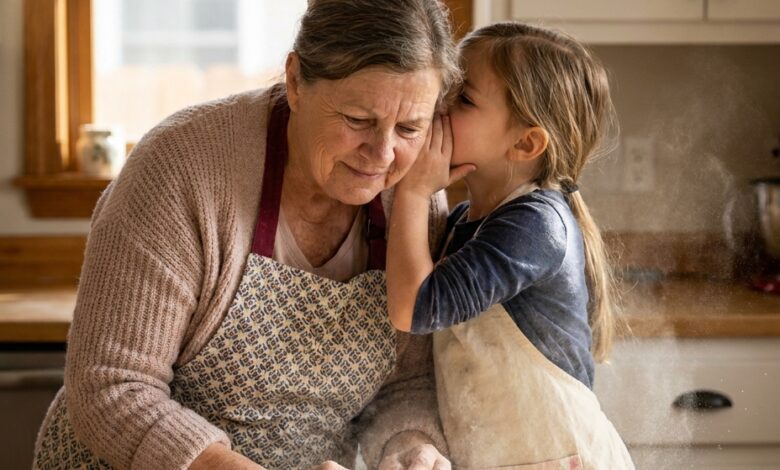
The confession came out of a six-year-old between cookie batter and sprinkles, at 3:20 on a Tuesday afternoon, the way children hand you a live grenade like it’s a dandelion. “Grandma, I’m really good at the counting game now. But you can’t tell Daddy.” My granddaughter Ruby, flour on her nose, went on to describe it with the pride of a girl who’d been told she was special: Miss Kayla — my widowed son’s girlfriend of eight months — had Ruby count cash into envelopes against a timer, rewarded her speed with donuts, and drove her to “the mailbox stores, not the regular mailbox, the ones with the little boxes inside with numbers.” Sometimes five envelopes. The fat ones were hard. And then the sentence that stopped the wooden spoon in my hand: “Miss Kayla says when the counting game is over, we’re going to live somewhere warm and I can have a bunk bed.” We. Not Daddy. I gave Ruby the beaters to lick, stepped into the pantry, and called the one person on earth who loved that little girl as much as I did and carried a badge for twenty-nine years doing it — her other grandfather, Big Ray.
You have to understand what our family was by then to understand how Kayla got so far inside it. Ruby’s mother — Big Ray’s daughter, my daughter-in-law Marisol — died two years ago at thirty-four, and grief made all of us softer and stupider than we’d ever been. When Danny met Kayla, he smiled for the first time in a year, and I decided liking her was my job. So I said nothing when she moved in at month three. Nothing when she “took over the bills” because Danny had enough on his plate. Nothing when Marisol’s life insurance payout — $340,000, sitting in savings for Ruby’s future — became something Kayla referred to as “our cushion.” Nothing when she got herself on the school pickup list, which is how she had my granddaughter alone every afternoon between 3:00 and 5:30. The warning signs weren’t hidden; they were laminated. And the deadline gave the whole thing its shape: that coming Thursday, at an appointment Kayla herself had scheduled, my son was going to add her to the deed of the house and to every account he owned. “It just makes me feel like real family,” she’d said at Sunday dinner, squeezing his hand. Thursday was two days away.
Big Ray listened to me repeat Ruby’s words — bunk bed and all — and then this gentle mountain of a man went quiet in a way I’d only heard once before, at his daughter’s funeral, and said, “Finish the cookies. Don’t call Danny. Tomorrow we play the counting game my way.” What he did in the next thirty-six hours was patient, legal, and surgical. Wednesday morning he took Ruby and me for pancakes and let his granddaughter proudly navigate him to “her” mailbox stores — three private mailbox franchises across two towns, where a retired detective’s calm questions and one phone call to a former colleague in the financial crimes unit established what Ruby’s envelopes had been feeding: two commercial mail receiving boxes rented under a name that was not Kayla Brennan, because Kayla Brennan did not exist. Her real name matched an open theft-by-deception case two states over and a previous engagement to a widower in Ohio whose accounts had been emptied eleven days after he added her to them. The cash Ruby counted was Danny’s — skimmed in ATM increments small enough that a grieving man doesn’t notice, converted to money orders at those mailbox stores, and mailed ahead to “somewhere warm”: a Florida address already receiving her packages. Wednesday night, Big Ray sat in my kitchen with a detective named Alvarez, a folder of photographs, and my son Danny, and slid the folder across the table without a word. I watched my boy read for four minutes. Then he looked up with his late wife’s insurance statements in his hand and asked the only question left: “She’s meeting me at the bank at ten tomorrow. What do you want me to do?” Alvarez smiled slightly and said, “Keep the appointment.”