The Biker Who Hit My Son Visited Every Day—Until My Son Finally Woke Up and Spoke One Word
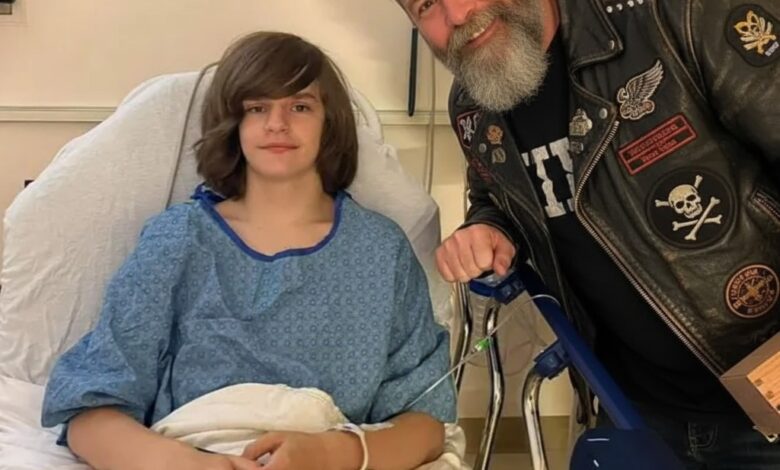
The first time I saw the man who hit my son, I wanted nothing more than for him to disappear from our lives completely and permanently.
My name is David, and my son Jake was twelve years old when a motorcycle came around a corner on a Tuesday afternoon and changed everything. Jake had run into the street chasing a basketball — the kind of thing twelve-year-old boys do without thinking, the kind of thing that happens in a single second and cannot be un-happened no matter how many times you replay it looking for the moment where a different choice leads somewhere different. The police came to our door and told us the rider had stayed at the scene, had called 911 immediately, had performed CPR until the ambulance arrived. They told us he had not been speeding, had not been drinking, had done nothing wrong — that the accident was exactly that, an accident, the collision of two trajectories that no one had arranged and no one could have predicted. I heard all of this information and understood none of it in the way that understanding is supposed to work. The only fact that penetrated was that my son was in a hospital bed with tubes and machines and doctors using words like swelling and pressure and wait, and that someone on a motorcycle had put him there, and that the particular brand of grief and terror I was carrying needed somewhere to land. It landed on Marcus. That was the man’s name — Marcus, fifty-seven years old, a large quiet man with a gray beard and a leather vest covered in the patches of a motorcycle club that had been riding together for twenty years. I learned his name on day three, when I walked into Jake’s hospital room and found him sitting in the chair beside my son’s bed reading Harry Potter out loud in a low unhurried voice. He stood when I entered, slowly and carefully, and told me who he was before I could ask. He said it plainly and without excuse — I am the one who hit your son. I don’t remember precisely what I did next. I remember the corridor. I remember hospital security. I remember the head nurse telling Marcus he needed to leave and that the police would be called if he returned. He left. He came back the next morning. He came back every morning after that. My wife Sarah, who has always understood things more quickly than I do and extended grace more readily than I have ever managed, told the hospital staff to let him stay. He wants to be here, she said. And Jake needs everyone who is willing to come. I told her she was wrong. I told her that Marcus in that room was something I could not accept, that every time I saw him I saw the moment my son’s life changed, that his presence was not comfort but a daily reopening of something that needed to close. Sarah listened to all of this. Then she said — I know. But Jake doesn’t know any of that. Jake just hears someone who refuses to leave. And she was right. She was right about almost everything in those forty-seven days, which is one of the reasons I am still married to her and still grateful for it every morning.
What I didn’t know — what I was too deep inside my own grief and anger to ask about or look for — was why Marcus kept coming back.
Not the surface answer, which was guilt, which was obvious and which I had assigned to him immediately because it was the simplest explanation and the one that required the least examination of anything I didn’t want to examine. The real answer. The one Sarah found because she was still capable of having conversations in those weeks when I was barely capable of staying in the same building. Marcus had a son. Had — past tense, the specific grammar of loss that changes a sentence completely. His son Daniel had died eleven years earlier, at twenty-three, in an accident that Marcus had not been present for and had never fully stopped believing he should have somehow prevented. Eleven years of that. Eleven years of the particular guilt that attaches itself to fathers who were not where they needed to be when something irreversible happened, the guilt that doesn’t respond to logic or evidence or the reasonable arguments of people who love you, the guilt that simply stays because it has decided to. When Marcus hit Jake and Jake didn’t die — when Marcus stayed and called and performed CPR and held on until the ambulance came and Jake’s heart kept beating — Marcus had made a decision standing on that street that he was not going to be the man who left again. He was not going to be the father who was absent when a boy needed someone to stay. Jake was not his son. But Daniel had been, and Daniel was gone, and Marcus was standing on a street corner with a twelve-year-old boy who was still alive and still needed someone, and Marcus understood in that moment what he was going to do about it with a clarity that he said later felt like the first clear thing he had understood in eleven years. He was going to stay. Every day. For as long as it took. Sarah told me all of this on day twelve, sitting in the hospital cafeteria with bad coffee going cold between us. I listened without speaking for a long time after she finished. Then I said I needed some air and I went and stood in the parking lot for twenty minutes and thought about a man who had lost his son and spent eleven years carrying it and then found himself on a street corner with someone else’s boy and decided that leaving was something he was no longer willing to do. I thought about what it would take to make that decision. I thought about what it would take to keep making it every morning, through my anger and the hospital staff’s warnings and his own grief, day after day after day. I went back inside. I did not go to Jake’s room that day. But I stopped arranging my visits around Marcus’s departures. It was a small thing. It was the beginning of a larger thing.
On day nineteen, Marcus’s motorcycle club came to the hospital.
Not loudly. Not in the way that motorcycle clubs are sometimes imagined to arrive at places. They came quietly, in the early morning, fifteen men and four women in leather vests standing in the hospital corridor outside Jake’s room with their hands folded. A chaplain who rode with the club led them in a prayer for a twelve-year-old boy most of them had never met, the son of a man some of them knew only through Marcus’s daily accounts of his condition and his progress and the small signs that the doctors monitored and measured and reported with the careful optimism of people who have learned not to promise things they cannot guarantee. I stood at the end of the corridor and watched. I did not join them. I was not ready for that. But I watched, and something that had been held very tight in my chest for nineteen days loosened slightly — not enough to call it relief, not enough to call it forgiveness, but enough to breathe a little differently than I had been breathing. Marcus saw me watching. He nodded once. I nodded back. That was the entirety of our communication that day and it was enough. We talked for the first time — really talked, in complete sentences about things that mattered — on day twenty-three, in the cafeteria, over the same bad coffee that had become the unofficial currency of every difficult conversation that happened in that building. Marcus told me about Daniel. He told me the whole story without softening it or managing it or presenting it in the way that people sometimes present painful things to make them easier for the listener. He told me what he had carried for eleven years and what standing on that street corner with Jake had felt like and what he had decided and why. I am not asking you to forgive me, he said. I know that might not be possible and I understand if it isn’t. I’m just not able to leave. I looked at this large quiet man across a cafeteria table and understood something that I should probably have understood earlier. He was not in that hospital because it was comfortable or convenient or because it made him feel better about what had happened. He was there because staying was the right thing to do and he knew it and he kept doing it regardless of everything else. That is not a small thing. That is, I have come to believe, one of the largest things a person can do. We sat in that cafeteria for two hours. We talked about Jake and we talked about Daniel and we talked about accidents and guilt and the specific difficulty of loving someone you cannot protect from everything the world might do to them. We did not resolve anything, exactly. But we were two fathers sitting across from each other talking honestly about what it meant to be a father, and that was more than I had expected and more than I had been capable of a week earlier and it mattered. After that, I stopped avoiding Marcus entirely. We sat on opposite sides of Jake’s bed and took turns reading. We brought each other coffee from the cafeteria. We talked when we had something to say and sat in silence when we didn’t and both of those things became, over the days that followed, a kind of companionship I had not anticipated and would not have predicted and am still grateful for.
On the morning of day forty-seven, Jake moved his hand.
I was sitting in the chair on the left side of his bed and Marcus was sitting in the chair on the right and Sarah was standing near the window and the movement was small — just the fingers of his right hand, curling slightly against the blanket — but I had been watching my son’s hands for forty-seven days and I knew immediately what I was seeing. Sarah saw it at the same moment. Neither of us spoke. We both leaned forward at the same time, and the machines continued their steady rhythms, and the room held its breath. Then Jake’s eyes opened. They opened slowly, the way eyes open when the person behind them has been somewhere very far away and is making their way back through a great deal of distance. He looked at the ceiling first. Then he turned his head, very slowly, and his eyes moved across the room. They passed me. They passed Sarah. They stopped on Marcus. For a long moment, Jake looked at Marcus with the careful focused attention of someone locating something they have been searching for. Then he whispered one word. You. The room went completely still. Marcus leaned forward slightly. Jake’s voice was thin and rough from the tubes and the weeks of silence but the word was clear and the recognition behind it was unmistakable. Then Jake said — you saved me. The doctors had told us that coma patients sometimes hear everything happening around them, that they retain experiences from the period of unconsciousness in ways that are not fully understood. Jake remembered Marcus’s voice. He remembered forty-seven days of Harry Potter and one-sided conversations and the presence of someone who had decided not to leave. He also remembered the accident itself — Marcus braking hard, swerving, the impact, and then Marcus’s hands and Marcus’s voice telling him to stay, that help was coming, that he needed to hold on. The man I had believed had ruined my son’s life had held my son’s life in his hands on a street corner and refused to let it go. And then he had come to the hospital every day for forty-seven days and refused to let go of that either. Sarah was crying. I was crying. Marcus was crying without any attempt to hide it, which was the first time I had seen him do that openly and which told me something about what those forty-seven days had cost him and what Jake’s open eyes meant to him in a way that went beyond what words were adequate to carry. I walked around the bed and I put my hand on Marcus’s shoulder and I left it there. He put his hand over mine. We stayed like that for a while. It was enough.
Jake came home two months later, and his recovery was long and required more patience than any of us had known we possessed.
Marcus visited regularly throughout those months, and the visits changed in character as Jake got stronger — less solemn, more ordinary, the way relationships change when the crisis that created them recedes and what’s left is simply two people who have decided they like each other. Jake asked Marcus to teach him about motorcycles. Marcus arrived one Saturday morning with a small model kit and they spent four hours at the kitchen table building it together, Jake asking questions about every piece and Marcus answering with the patient detail of someone who has loved something for a long time and is glad to explain it. That became a regular thing. Saturday mornings, model kits, the kitchen table, Marcus’s patient voice and Jake’s increasingly specific questions. Jake started calling him Uncle Marcus somewhere around the third month, casually and without announcement, the way children assign titles when they have decided a relationship has earned one. Marcus came to Jake’s thirteenth birthday. He came to his first basketball game back. He is coming to his graduation, which is still a few years away but which Marcus has already put in his calendar because that is the kind of person Marcus is — the kind who puts things in his calendar and shows up and stays. It has been two years since the accident. Jake is fourteen now, healthy and loud and entirely unaware of how close we came to a version of this story that ended very differently. He knows the whole story — we told him when he was ready to hear it — and he understands it with the particular clarity that children sometimes have about things that adults complicate unnecessarily. Marcus is his Uncle Marcus, the man who stayed, the man who read Harry Potter for forty-seven days to a boy he didn’t know because leaving was something he had already done once and wasn’t willing to do again. I think about forgiveness sometimes — what it is and how it works and whether what I extended to Marcus in that hospital corridor was the real thing or something that only became the real thing later, in the cafeteria conversations and the chair beside Jake’s bed and the Saturday mornings with model kits at our kitchen table. I think it became real gradually, the way most real things do — not in a single moment of decision but in the accumulation of smaller moments, each one building on the last, until one day you look up and understand that something has changed that cannot be changed back. Marcus lost his son and carried that loss for eleven years and then found himself on a street corner with someone else’s boy still alive and made a decision about who he was going to be about it. I was wrong about him from the first moment I saw him. I am glad I was wrong. I am glad Sarah saw what I couldn’t see and held the door open until I was ready to walk through it. And I am glad that Jake, when he opened his eyes on the morning of day forty-seven after forty-seven days of someone’s voice refusing to leave him, looked across the room and knew immediately whose voice it had been. Some people show you who they are in the easy moments. Marcus showed us who he was in the hardest one imaginable, and then kept showing us every day after that, in a hospital corridor and a cafeteria and a chair beside a bed and a kitchen table covered in model motorcycle parts on a Saturday morning. My son calls him Uncle Marcus. My wife and I call him a friend. And sometimes, when I see them together in the garage on a weekend afternoon, I think about what my wife said on day three when I was too angry to hear it. Jake needs everyone who is willing to come. Marcus came. He never stopped coming. Some angels, it turns out, really do wear leather vests.