I Inherited My Grandparents’ $900K Estate and Quietly Put It in a Trust — Then My Sister Showed Up Saying She’d Had the House Transferred to Her Name. Two Days Later She Came Back With Movers and Found Out Exactly What I’d Done.
My name is Clare, and I am twenty-eight years old, and I want to tell you about the house.
Not about the inheritance, exactly, and not about my family, exactly, though both of those things are part of it. I want to tell you about the house first because the house is where everything begins and where everything ends, and because understanding what that house meant to me is the only way to understand every decision I made after my grandparents died. It was a Victorian built in the 1920s in Portland — the kind of house that stops people on the sidewalk. Original stained glass in the front windows that threw colored light across the floors in the afternoon. Antique woodwork that my grandfather had refinished by hand in his seventies because he said no one else would do it right. A garden my grandmother had tended for forty years, every plant chosen deliberately, every corner of it telling a story about a season or a person or a memory she wanted to keep close. I grew up in that house in the way that you grow up in a place that isn’t your home but feels more like home than anywhere else — spending weekends there, learning to cook in that kitchen, sitting on that porch in the evenings listening to my grandfather talk about things he never talked about anywhere else. When my parents favored my sister Julia — which they always did, openly and without embarrassment, the way some families favor one child and simply decide the other one is old enough to understand — my grandparents’ house was where I went to remember that I was valued somewhere. That I was seen by someone. That my quiet, dependable, number-crunching version of existing in the world was enough for the people who mattered most to me. So when Helen and Robert passed away within months of each other three years ago, and the will was read and everything was left to me — not split, not divided, not shared with my parents or my sister, but given entirely and deliberately to me — I understood exactly what they were saying. They were saying I had been there. I had shown up. I had sat with them through the hard parts and the boring parts and the parts that no one else wanted to sit through, and that was worth something. That was worth everything. My family’s reaction confirmed that I had understood correctly. The first question anyone asked me after the reading was not how I was holding up or whether I was okay — it was how soon I planned to share the inheritance. Julia cornered me in the parking lot and asked if I was going to do the right thing and split it evenly, as if doing the right thing meant giving half of what my grandparents had specifically chosen to leave to me to the sister who hadn’t visited them in years because she was too busy chasing an influencer career that never quite worked out. That conversation in the parking lot was the moment I understood that whatever came next, I needed to be prepared for it.
I hired a lawyer named David Morrison within the week.
David was methodical and careful and exactly the kind of person you want when the people who are supposed to love you have just shown you that they have been calculating things you didn’t know they were calculating. He advised me to place everything into a trust — the house deed, the savings, the investments, the life insurance proceeds — so that no one could manipulate, forge, contest, or seize any of it. Within three months it was done. David became the trustee. I remained the sole beneficiary. The legal architecture around my inheritance was as solid as anything David had built in thirty years of practice, and he told me so with the quiet confidence of someone who has seen enough family disputes to know what protection actually looks like. I didn’t tell my family what I had done. I didn’t tell anyone. I moved into the house, restored the rooms that needed restoring, planted new things in my grandmother’s garden alongside the plants she had left behind, and built a quiet life inside walls that finally and completely belonged to me. My family kept their distance for a while, surfacing at holidays to make small pointed comments about me living the dream, about the house being wasted on someone who worked from home and didn’t entertain, about what Helen and Robert would have really wanted if they had thought it through properly. I listened and said very little and went back to my life. I didn’t realize until much later that the comments weren’t cruelty for its own sake — they were reconnaissance. They were biding their time, all of them, waiting for an angle I hadn’t thought to close.
Last Wednesday I came home to find Julia and my mother Karen standing on my porch.
They were smiling in a way that made my stomach tighten before I had even gotten out of the car — the particular smile of people who believe they have already won something and are enjoying the moment before they tell you. Julia was wearing the kind of outfit she wore when she wanted to be photographed, which told me she had thought about how this moment was going to look. My mother had her arms loosely crossed, her chin slightly raised, her expression arranged into the specific configuration that meant she had decided something and was not interested in discussion. I let them in because I didn’t yet understand what I was letting in with them. They moved through my house the way people move through a space they have already decided belongs to them — slowly, glancing around, touching nothing but assessing everything. My mother said I had done a nice job with the place, dryly, the way you compliment a hotel room before you check out. Then Julia turned and told me the house had been officially signed over to her and I needed to be out by Friday. I stood there and made her repeat it because I genuinely thought I had misheard. My mother stepped forward with her arms crossed and told me I had heard correctly. Some people, she said, simply couldn’t handle good fortune. It was time for someone more deserving to have it. I asked how exactly they had managed a transfer of property that I owned free and clear, and Julia explained with a casual shrug that they had come across old records showing unresolved debts in my grandparents’ estate. Since I hadn’t been managing the property properly, she said, it had needed to be liquidated, and she had purchased it to cover those debts — legally. She produced a stack of papers and slid them across my kitchen table with a smirk that she had probably practiced. I looked at the papers. They were convincing in the way that forged documents prepared by people who are not lawyers are convincing — detailed enough to seem official, wrong in ways that only someone who knew the actual legal structure would immediately recognize. There were no debts. My grandparents had died with their estate in order. David had verified every line of it. Whatever these papers were, they were not what Julia believed them to be. But I didn’t say any of that. I looked at the papers for a long moment and then I looked at my sister and my mother standing in my kitchen with their cold smiles and their certainty, and I said — you really think I would let this happen after everything I’ve learned about this family? My mother’s smile flickered slightly. Julia’s didn’t. She told me to start packing. They let themselves out, and I listened to their footsteps cross the porch and descend the steps and I stood in my kitchen in the house my grandparents had left me and I made one phone call. To David. I told him what had happened. He was quiet for a moment and then he said he would take care of it, and I knew from the way he said it that he meant something specific by that phrase.
Friday morning arrived the way mornings arrive when something is about to happen — ordinary on the surface, charged underneath.
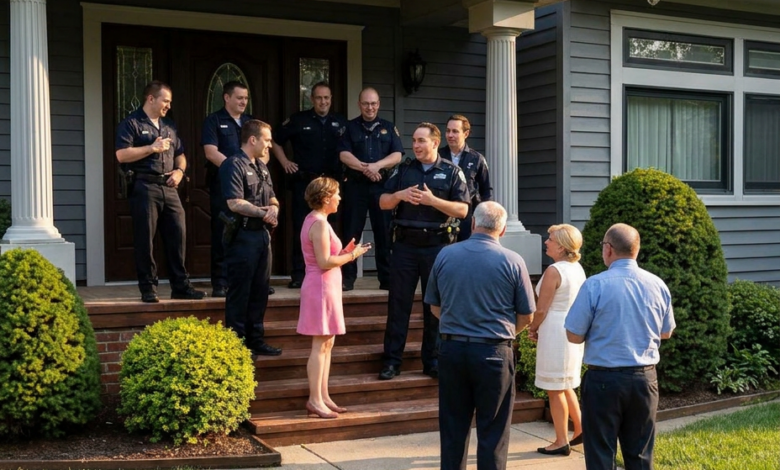
I was in the kitchen when I heard the vehicles on the street. A moving truck. My sister’s car. My mother’s car. And behind those, my father Michael’s car, which surprised me because my father had always preferred to let my mother lead these things and step in only to add weight to a conclusion that had already been reached. I looked out the front window and watched them get out — Julia in another carefully chosen outfit, my mother already talking, my father scanning the house with the expression of a man who had convinced himself he was doing something reasonable. They had brought three movers with them, large men in work clothes who had no idea what they had been hired to walk into. They started up the front path with the confidence of people executing a plan that has been carefully prepared. And then they stopped. Because standing on the porch of my house, arranged in a line with the particular stillness of people who have been waiting and are prepared to wait longer if necessary, were David Morrison and four other individuals — two of them law enforcement officers, two of them associates from David’s firm, all of them holding documents, all of them looking at the people coming up the front path with expressions of complete and professional calm. David was in the center. He was holding a folder. He had the look of a man who has spent thirty years preparing for exactly this kind of morning and finds it, if anything, slightly less dramatic than he expected. Julia stopped walking first. Then my mother. Then my father, who looked at the porch and then at my mother and then back at the porch with the expression of someone who is beginning to understand that the plan may have had a flaw. The movers stopped behind them, uncertain. Nobody said anything for a moment. Then David opened the folder and began to speak in the clear, unhurried voice of someone who has prepared a great deal to say and intends to say all of it. He explained that the property at this address was held in an irrevocable trust established three years earlier, of which he was the named trustee and I was the sole beneficiary. He explained that no transfer of this property had occurred, could occur, or would occur without his authorization as trustee, and that the documents my sister had presented to me two days earlier had been reviewed by his office and found to contain fraudulent misrepresentations of the estate’s debt status, which had been reported to the relevant authorities that morning. He explained that the individuals present in law enforcement capacity were there in connection with that report and would like to speak with Julia and Karen at their convenience, and that convenience, from their perspective, meant now. He said all of this in the same tone you might use to explain a bus schedule. My sister’s face went through several expressions in rapid succession — confidence, confusion, the beginning of anger, and then something that looked like the ground dropping out from underneath her. My mother said something sharp and quick that I couldn’t fully hear from inside the house. My father took a step backward, then stopped himself, then didn’t seem to know what to do with his hands. The movers looked at each other and then at the truck and then began the process of quietly removing themselves from a situation they had not been paid enough to be part of. David looked at my family on the front path with their smug grins that were no longer quite smug and their certainty that was no longer quite certain, and he waited. He was very good at waiting. I came out onto the porch then and stood beside him, and I looked at my sister and my mother and my father in the morning light on the path that led to a house that had always been mine and would always be mine, and I didn’t say anything at all. I didn’t need to. The papers in David’s folder said everything that needed to be said, and they said it in the only language my family had ever been willing to fully believe — the language of legal fact, of documented truth, of preparation that had been done quietly and carefully by someone they had underestimated from the beginning.
The legal process took several weeks to resolve fully.
The fraudulent transfer documents were traced to a notary my sister had hired through a contact she found online, someone who had agreed for a fee to produce paperwork that appeared official without verifying any of the underlying claims. The notary cooperated immediately when law enforcement became involved. Julia faced a civil fraud complaint and a conversation with a prosecutor that I understand was not comfortable for her. My mother hired her own lawyer, who reviewed the situation and advised her that there was no viable path forward given the trust structure and the documentation David had assembled. My father called me once, about three weeks after the morning on the porch, and said that he thought things had gotten out of hand and that family was supposed to mean something. I told him I agreed completely and that I had believed that for my entire life, and that the difference between us was that I had acted accordingly. He didn’t have an answer for that. I haven’t heard from any of them since, and I find that the silence feels less like loss and more like the particular peace of a house where all the right things are finally in their proper places. My grandmother’s garden is extraordinary this year. The stained glass in the front windows still throws colored light across the floors every afternoon at the same angle it always has, and I still stop sometimes in the middle of whatever I am doing just to watch it move across the room. Helen and Robert knew what they were doing when they left me this house. They knew who had been there. They knew who would take care of it. And they knew, I think, that the quiet dependable daughter who crunched numbers for a living was also the one who would do whatever was necessary to protect what they had entrusted to her. They were right about that. They were right about everything.